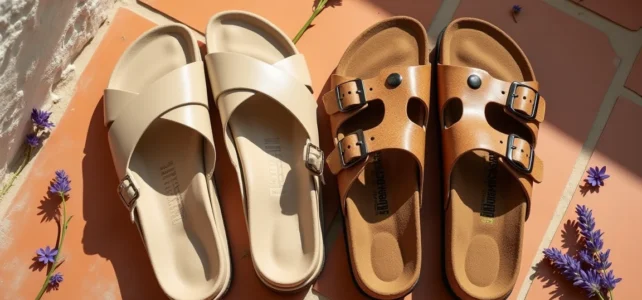
Comparing the breathability of two sandals goes beyond just the comfort felt. Billowy and Birkenstock start from opposing design philosophies, with materials, soles, and target uses that hardly overlap. Billowy sandals, often associated with children’s models and aquatic uses, rely on EVA and lightweight construction. Birkenstock builds its reputation on cork, leather, and a foot support close to orthopedic.
The question of breathability in summer deserves to be asked based on the actual context of wear, not just the brand.
EVA vs. cork: two approaches to heat management
The clearest distinction between these two brands lies in the sole and its behavior in relation to sweating. Billowy heavily uses EVA (ethylene-vinyl acetate), a lightweight expanded polymer that does not retain water. This material allows for quick drying after contact with water, making it suitable for humid environments: beach, pool, outdoor shower.
Birkenstock relies on a sole made of cork and natural latex, covered with a layer of suede or leather. Cork partially absorbs moisture from the foot and gradually releases it, creating a slower but more consistent thermal regulation. In contrast, this material takes longer to dry completely if the sandal is wet.
For those looking for reviews of Billowy sandals in a summer context, this material difference conditions everything else: immediate feeling of coolness with EVA, regulated thermal comfort with cork.
Neither approach is superior in absolute terms. The choice depends on the type of heat experienced: urban dry heat or humid heat by the sea.

Breathability in urban walking: context changes everything
Content that compares sandals often limits itself to general comfort without distinguishing wear situations. Perceived breathability, however, varies depending on whether the foot is static (terrace, office) or in motion (prolonged walking in the city, sightseeing).
In urban walking on hot asphalt, Billowy’s EVA sole heats up faster when in contact with the ground. The material conducts more heat from the surface to the sole of the foot. Birkenstock’s cork, denser and with a natural honeycomb structure, insulates the foot better from the heat of the ground.
Conversely, for a light stroll on sand or grass, EVA retains the advantage: the foot stays dry, the sandal doesn’t get heavy, and the ventilation between the open straps compensates for the lack of absorbent material.
The role of the upper and straps
Breathability is not solely determined underfoot. Billowy models adopt very open designs, sometimes reduced to two thin straps. This maximum exposure of the foot to the open air promotes sweat evaporation.
Birkenstock offers various configurations, from the Arizona model (two wide straps) to the Boston model (closed clog). The more the upper covers the foot, the less natural ventilation works. On open models like Arizona or Mayari, air circulation remains adequate, but the leather or suede of the straps retains more heat than plastic or synthetic textile.
- Billowy favors thin straps made of synthetic materials, quick-drying and less insulating, maximizing ventilation
- Birkenstock uses leather or Birko-Flor (coated synthetic), thicker and slower to wick moisture at the strap level
- Birkenstock models with a back strap (like Kumba) further reduce the surface exposed to air compared to open mules
Durability of breathability: what changes after several weeks of wear
One aspect rarely addressed is the evolution of breathability over time. A new sandal and a sandal worn daily for two months do not behave the same way.
Birkenstock’s cork gradually compresses under the weight of the foot, creating a personalized footprint. This compression slightly reduces the absorption capacity of the sole but improves contact and stability. The thermal regulation of cork decreases with wear, especially if the upper suede layer is saturated with accumulated sweat without regular cleaning.
Billowy’s EVA, on the other hand, retains its quick-drying properties longer, as the material does not absorb deeply. Some users report a loss of flexibility in the EVA after an intensive season, which may change the contact with the foot without directly affecting breathability.
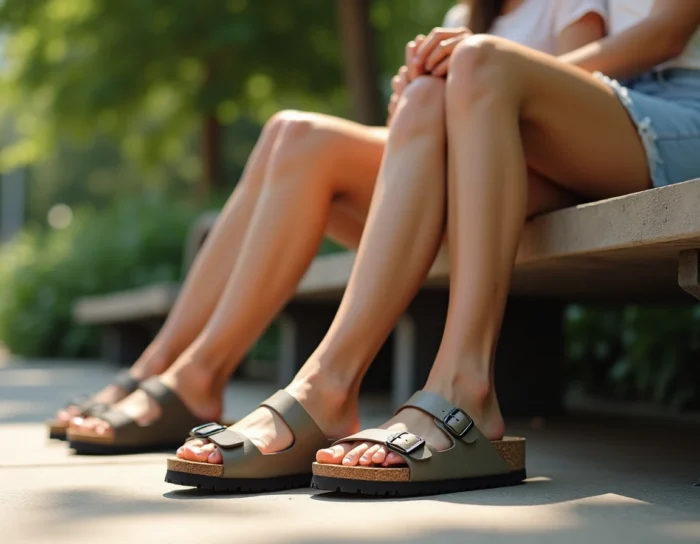
Billowy or Birkenstock sandals: for what summer use
Rather than designating a winner, it is more useful to reason by situation.
- For beach, pool, or aquatic activity use, Billowy offers quick drying and superior ventilation thanks to EVA and very open designs
- For prolonged urban walking in high heat, Birkenstock better isolates the foot from the hot ground and provides support that reduces friction (and thus sweating related to rubbing)
- For mixed daily wear (indoor/outdoor, short trips), both brands are equal, but Birkenstock leather requires more regular maintenance to retain its properties
- For children, Billowy remains the most widespread reference, with lightweight and easy-to-clean models that adapt to growing feet
The perceived coolness depends as much on the material as on the chosen model, the walking surface, and the duration of wear. A Birkenstock Arizona worn barefoot on cool tiles and an open Billowy on hot sand tell different stories.
Choosing based on terrain and activity remains the most reliable criterion, well ahead of the brand name.