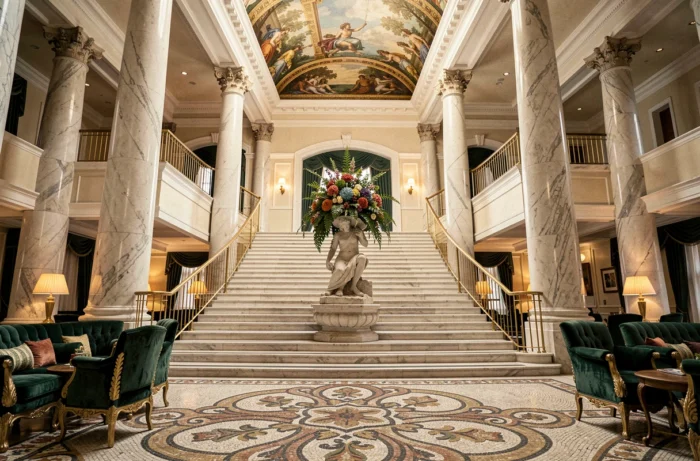
No hotel classification organization in the world awards more than 5 stars. Neither the Hotelstars Union in Europe, nor the Forbes Travel Guide, nor the American AAA system has ever created a 6, 7, or 8-star category. Therefore, talking about an 8-star hotel means entering a territory where marketing replaces standards, and where the claimed level of service escapes any verifiable scale.
8-Star Hotel: A Designation Without an Official Scale
The confusion dates back to the late 1990s. When the Burj Al Arab opened in Dubai, a British journalist referred to the establishment as a “7-star” hotel to convey the gap between what he discovered there and classic 5-star hotels. The expression was picked up by the international press and then by the hotel’s own marketing services.
Since then, every new ultra-luxury establishment that exceeds known standards claims an additional star. The leap from 7 to 8 stars corresponds to no audit or published criteria grid. The mention of 8 stars is purely a communication tool, intended to signal an extraordinary pricing and experiential positioning.
To better understand what 8-star hotels around the world entail, one must look beyond the number of stars displayed and focus on the concrete services that distinguish these addresses.

Ultra-Luxury Services: What Sets These Hotels Apart from Classic Palaces
A 5-star palace already offers concierge service, a spa, gourmet dining, and spacious suites. What does an establishment claiming 8 stars offer in addition?
The difference lies in three main areas.
Total Personalization of the Stay
In these establishments, each guest has a dedicated butler available at all times. The service goes beyond responding to requests: it anticipates them. The contents of the minibar, the room temperature, the pillows, and the music playlist are adjusted before the traveler’s arrival, often based on a profile updated with each stay.
Architecture as an Experience in Itself
The building itself becomes the main attraction. The Burj Al Arab, shaped like a sail on an artificial island, is the most well-known example. Other establishments invest in underwater suites, suspended pools between two towers, or rooms integrated into natural geological structures. The design does not decorate the stay: it defines it.
Access to Unavailable Experiences Elsewhere
- Private dinners prepared by Michelin-starred chefs in locations closed to the public (desert, private island, rooftop of a skyscraper)
- Transfers by helicopter or private yacht included in the suite rate
- Wellness programs tailored with specialized practitioners, sometimes over several days
- Private art galleries or collections accessible only to hotel residents
These services do not appear in any classification reference. They stem from a deliberate commercial positioning, not from a regulatory obligation.
Dubai and the United Arab Emirates: Epicenter of Self-Proclaimed 8-Star Hospitality
Why do these extraordinary designations almost always come from the Gulf? The answer lies in the absence of binding regulations on stars in this region. In the Emirates, no public body regulates classification beyond 5 stars, which leaves operators free to claim whatever number they wish.
The Burj Al Arab remains the benchmark. Its two-level suites, columns covered in gold leaf, and helipad on the roof have established an image that all competitors strive to match or exceed. Other addresses in Dubai and Abu Dhabi follow the same logic: massively investing in spectacular architecture and extreme services to justify some of the highest rates on the planet.
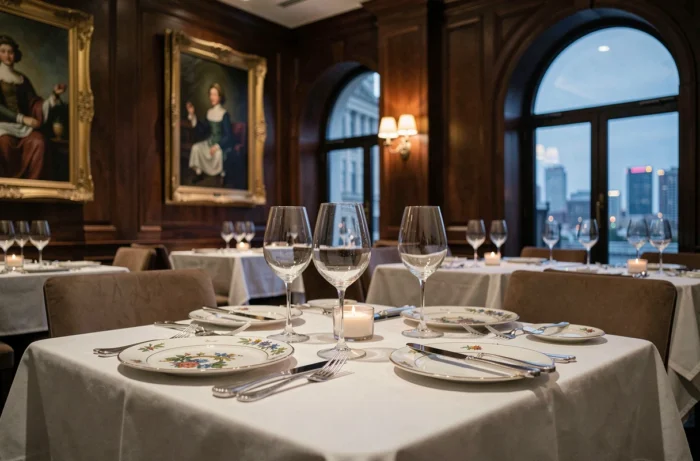
In Europe, the approach is different. France created the “Palace” distinction in 2010, awarded by Atout France to 5-star hotels meeting additional criteria of location, history, gastronomy, and service. The Palace label is the only official system that recognizes a level above 5 stars, but it remains anchored in a regulated framework.
Extreme Luxury and Sustainability: An Increasing Contradiction
Hotel ultra-luxury relies on abundance: water, energy, space, rare materials. This logic comes into direct tension with current environmental demands.
Some establishments positioned in the ultra-high-end segment are beginning to integrate carbon offset programs, solar desalination systems, or constructions using local materials. The Six Senses group, for example, combines ultra-luxury suites with measurable environmental commitments in several of its properties.
The challenge for these hotels is to maintain the expected level of service while reducing their footprint. An establishment claiming 8 stars without a visible environmental policy risks increasing reputational damage with a wealthy clientele that is becoming more sensitive to these issues.
Should We Believe in Stars Beyond 5?
You may have noticed that the same hotels appear sometimes rated 7 stars, sometimes 8, depending on the source? This is normal: without a scale, each website, each magazine assigns the number that suits them.
- The Forbes Travel Guide rates establishments on three levels (Recommended, Four Star, Five Star) without going beyond
- The Hotelstars Union, which covers most European countries, strictly caps at 5 stars with verifiable criteria (minimum room size, staff/client ratio, mandatory amenities)
- The American AAA system stops at 5 diamonds, again with a public evaluation grid
No independent audit validates the 8-star designation. When an establishment uses this term, it self-awards a distinction that no one else can confirm or deny.
The informed traveler thus benefits from focusing on actual services rather than the displayed number. A Parisian palace distinguished by Atout France or a Five Star from the Forbes Travel Guide offers verifiable guarantees. A self-proclaimed 8-star hotel may provide an extraordinary experience, but the promise relies entirely on the establishment’s word, not on external verification.