Steel protective grids withstand UV rays, acid rain, and thermal shocks season after season. Their mechanical robustness makes one forget that they degrade silently, often due to micro-initial rust spots invisible from the ground. Understanding how to handle, inspect, and treat them at the right time radically changes their lifespan, without requiring a complete stripping every year.
Localized touch-ups on steel grids: avoid complete stripping
The classic reflex is to sand the entire grid as soon as a rust spot appears. This approach wastes time, weakens the healthy coating around the corroded area, and exposes more bare metal to ambient moisture.
The alternative method relies on a close visual inspection twice a year, in spring and late autumn. One identifies flaking, paint blisters, and orange traces at the junctions between bars and frame, where water stagnates.
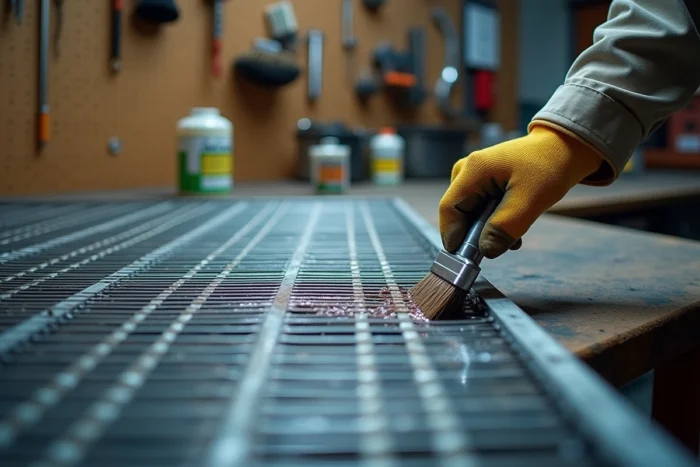
On these specific areas, targeted manual brushing (metal brush or medium-grit abrasive) is enough to reveal the healthy metal. A rust converter is then applied, followed by a coat of anti-rust primer before finishing. The rest of the grid remains untouched. Field reports vary on the ideal frequency of these touch-ups, but the principle remains constant: treating early and locally costs less than deferred total stripping.
A detailed guide on handling steel protective grids confirms the value of this preventive logic compared to heavy curative intervention.

Handling gestures and risks of mechanical damage
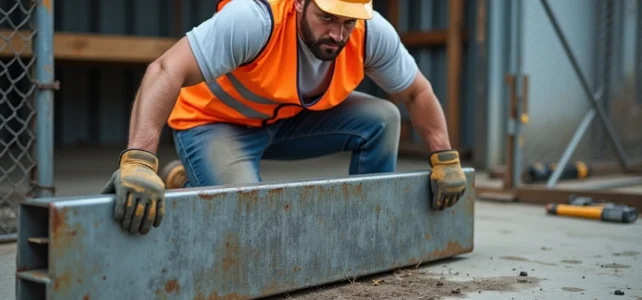
A steel defense grid weighs enough that improper handling during removal or transport can cause deformations. A bent bar, even slightly, creates a tension point where the paint cracks faster, opening the door to corrosion.
Removing and re-installing without breakage
Before any intervention, locate the fixings (chemical seals, screw brackets, hinges). Forcing a stuck anchor with an unsuitable lever deforms the frame. It is better to loosen it beforehand with a penetrating product, then pull along the axis of the seal.
- Carry the grid with at least two people, keeping it vertical to limit the bowing of the central bars.
- Place the grid on wooden or rubber wedges, never directly on the concrete floor or gravel, which can scratch the coating.
- Protect the corners with thick cardboard or fabric during transport, as these are the first impact areas.
A scratched coating during handling rusts faster than a naturally aged coating. The scratch creates a clean notch in the protective layer, while normal aging remains gradual and superficial.
Choosing the coating according to outdoor exposure
Not all finishes are equal against climatic aggressions. The choice depends on the orientation of the facade, proximity to the coast, and the level of air pollution.
Powder coating and galvanization: two complementary approaches
Powder coating sprays a polyester resin powder onto the steel, then bakes it in an oven. The resulting film resists UV rays well and offers a wide range of colors. However, it does not protect if the layer is pierced down to the metal.
Hot galvanization immerses the steel in a bath of molten zinc. The zinc sacrificially protects the steel electrochemically, even if the surface is scratched. It provides cathodic protection, which is more effective in humid environments over the long term.
The combination of both, known as a duplex system (galvanization followed by powder coating), offers the best durability known for grids exposed on a north facade or by the sea. The available data does not allow for precise quantification of the gain in years, but metallurgy professionals agree on a significant extension compared to each treatment taken in isolation.
Classic paint: when and why to settle for it
For a grid sheltered under a canopy or positioned on a protected south facade, an anti-rust oil-based paint applied over a primer remains a coherent choice. The cost is lower, and localized touch-ups can be done with a simple can and brush, without specialized equipment.
The trap to avoid: applying acrylic paint (water-based) directly on the steel without primer. The adhesion is poor, and flaking often occurs as early as the first winter.
Corrosion prevention between two maintenance seasons
Corrosion is not limited to visible rust. It progresses under the paint, in crevices, at weld points. Two simple habits significantly slow down this process.
- Rinse the grids with clear water after each episode of saline rain or intense pollution (sea spray, nearby roadworks). Salt and acidic particles accelerate oxidation as soon as they dry on the surface.
- Check the water drainage at the window supports. A grid with a low crossbar regularly submerged in a puddle rusts by capillarity, from the inside out.
- Apply a thin layer of protective wax or marine grease on the fixing areas, especially if the screws or bolts are made of non-stainless steel.
Rust between the bar and frame progresses from the inside, where no paint reaches. This is why galvanization, which also protects hidden surfaces, makes perfect sense on welded assemblies.
Adapting the maintenance strategy to the type of coating and the actual exposure of each grid remains the most effective lever. A biannual inspection, a few targeted touch-ups, and a coating suited to the environment are enough to keep a steel grid in good condition for many years, without resorting to complete stripping that many still consider a necessary step.