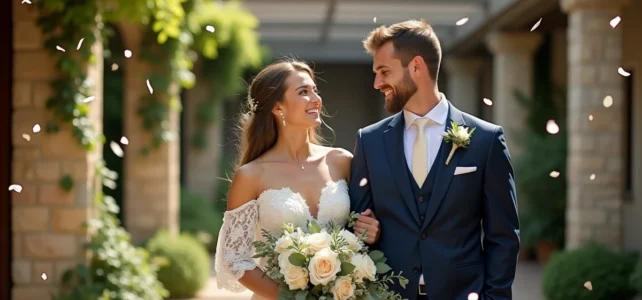
Organizing a personalized wedding doesn’t start with choosing a venue or a dress. The starting point is knowing what truly matters to the couple, what deserves an investment of time and money, and what can be lightened without regret.
Couples getting married today are often older than they were a few decades ago, with rich life experiences, sometimes children, shared assets, or blended families. This reality profoundly changes the way the day is conceived.
Personalized Wedding: Prioritize Before Decorating
The real lever for personalization is not found in decoration or themes, but in budgetary choices. More than half of couples exceed their initial wedding budget. The problem does not stem from a lack of rigor, but from a poor hierarchy of priorities.
Before opening a spreadsheet, ask yourself a simple question: what are the two or three moments of the day that your guests will still be talking about in five years? For some couples, it’s the meal. For others, the music or the secular ceremony. Focusing the budget on two strong areas rather than spreading it evenly yields a much more impactful result.
On nuptialement.fr, feedback from couples shows that this logic of prioritization transforms planning: less stress, more intentional choices, and a day that truly reflects the couple.
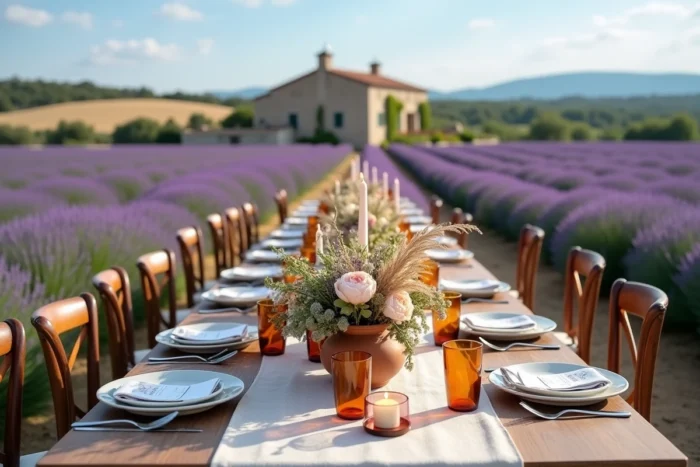
In practical terms, this means accepting to reduce certain areas. A simple table centerpiece with candles and a few seasonal flowers costs a fraction of an elaborate floral arrangement, without compromising the ambiance. In contrast, a mediocre caterer or a DJ who fails to read the room is immediately noticeable.

Secular Ceremony and Couple Rituals: What Makes a Wedding Unique
The civil ceremony at the town hall is a legal requirement in France. The religious wedding, if desired, can only take place after the civil celebration. This administrative framework leaves little room for personalization.
It is the secular ceremony that allows you to tell your story. Unlike a standardized model, it is built from your words, your loved ones, and your shared references. Why this choice? Because a ritual invented by the couple has an emotional impact that ready-made formulas cannot achieve.
Rituals That Work Beyond Trends
Some rituals transcend trends because they create a moment of transition that is perceptible to all guests. A successful ritual involves both partners in a common gesture, visible and understandable without explanation.
- The sand ceremony, where each partner pours colored sand into a shared vase, works well for couples with children who can participate in the gesture
- The cross-reading of letters written in secret before the big day evokes authentic emotion, provided each reading does not exceed two minutes
- The “wine box ritual” involves sealing a bottle and letters in a box to be opened on a specific wedding anniversary, extending the memory beyond the day
A common pitfall: multiplying rituals. One well-chosen ritual is better than three strung together without a break. The pace of the secular ceremony deserves as much attention as its content.
Couples Marrying Later: Adapting the Day to Their Real Life
The average age of people getting married has significantly increased compared to previous generations. This is not a sociological detail; it is a factor that changes the very nature of the celebration.
A couple marrying at 38 does not have the same expectations as a couple of 24. The guests are also different: young children, grandparents with mobility constraints, friends coming from afar with tight schedules. Adapting the logistics to the actual composition of the guest list is a form of personalization often overlooked.
Blended Families and Children Already Present
When children are already part of the household, including them in the ceremony is not a decorative bonus; it is an emotional necessity. Assigning them a concrete role (carrying the rings, reading a short text, walking down the aisle with a parent) gives meaning to the day for the entire family.
For second marriages, the tone of the celebration benefits from adjustment. A shorter but more intense evening, a brunch the next day instead of an entire night of dancing, a quality seated meal rather than a giant buffet: these choices reflect a maturity that does not need justification.
Wedding Vendors: How to Identify Those Who Serve Your Vision
Choosing a wedding vendor is not just about comparing quotes. The most reliable criterion is their ability to rephrase your request in their own words after an initial exchange. A photographer who shows you a beautiful portfolio but asks no questions about your couple’s story will produce generic images.
- Ask each vendor to describe the last wedding they found successful and why; their response reveals their priorities
- Check that they have previously worked at your reception venue or a similar space, as technical mastery of a space changes the quality of the outcome
- Prefer vendors who set clear boundaries (minimum number of hours, delivery times, cancellation conditions) rather than those who say yes to everything
A vendor who says no to certain requests protects the coherence of your day. This is a sign of professionalism, not a commercial flaw.
Every choice, from the menu to the ceremony ritual, benefits from telling something true about the people getting married. When guests leave saying “it was really them,” the goal is achieved.