
On Monday morning, the laundry basket is overflowing, the pile of 6-month onesies is still lying around in the eldest’s room, and no one can find the sports pants for Wednesday. Managing the clothes of an entire family is not a traditional storage problem: it’s a flow problem. Clothes come in (purchases, gifts, growth), circulate (wearing, washing, drying, ironing), and go out (too small, worn out, donated). When you don’t control this circuit, you accumulate.
Clothing rotation by size and season: the real lever
Most families store too many clothes at the same time. They keep summer clothes in children’s drawers in the middle of winter, sizes that have been outgrown for three months, and items “just in case.” The result: overcrowded wardrobes and chaotic mornings.
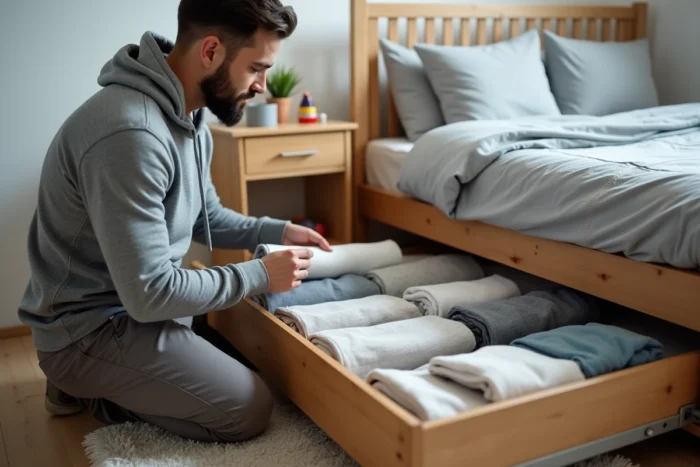
The most effective solution is to only keep accessible what corresponds to the current size and season. Everything else should be removed from the room. You can use stackable plastic bins, vacuum-sealed bags, or labeled boxes, stored high in a closet or in the garage.
For young children, create a bin for each size: 3 months, 6 months, 12 months, etc. When putting away clothes that have become too small, sort them directly into two categories: those to keep for a future baby and those to remove from the household. This habit prevents the gradual congestion that turns a child’s room into a textile warehouse.
To facilitate this rotation, you can access Hylla for families and centralize the tracking of sizes, available items, and what needs to circulate from one child to another.
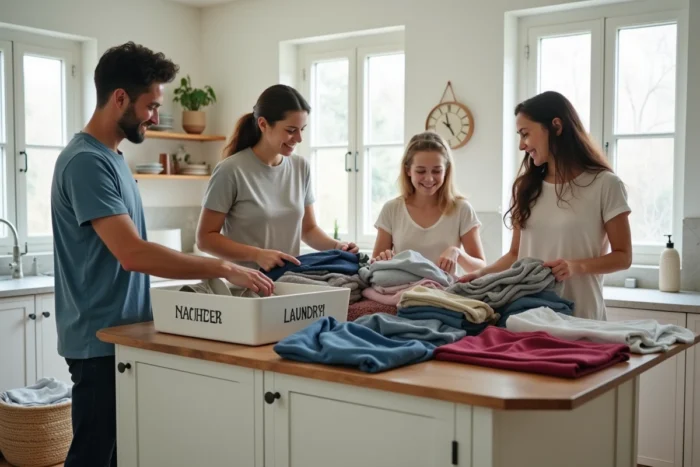
Family laundry routine: frequency and washing circuit
Dirty laundry is the bottleneck in clothing management. It’s not the machine that’s the problem; it’s the lack of a clear circuit between the dirty basket and the return to the drawer.
Establish a fixed laundry schedule
With children, two to three loads a week are often not enough. You save time by assigning fixed slots rather than reacting to the overflowing basket. For example: one load every evening, started after dinner, hung up before bedtime. The routine sets in within a few days.
For families using a dryer, the sequence of washing and drying on the same evening allows for folding the next morning. The laundry doesn’t stagnate on the drying rack for three days.
Separate laundry by person rather than by color
Sorting by color (white, colors, black) makes sense for a couple. For a family with children of different ages, sorting by person simplifies putting away after drying. You take out the load, fold it, and place it directly in the correct room. No tedious redistribution.
Responses vary on this point: some families prefer to maintain color sorting to protect light textiles. The decision depends on the daily laundry volume and tolerance for mixing.
Limit the number of clothes per child: the family capsule wardrobe
We often buy too many clothes for children, out of reflex or anticipation. The problem is that each additional item increases the volume of laundry to manage, the storage space needed, and the time spent organizing.
An effective approach: define a target number of items per category and per child. Here’s a concrete example for a preschool child:
- Seven tops (t-shirts or sweaters depending on the season), to cover the week without emergency laundry
- Four or five bottoms (pants, shorts), including one pair of joggers for sports
- Two “dressy” outfits for occasions, stored separately to avoid cluttering daily wear
- One seasonal coat and one mid-season jacket, no more
When you exceed this volume, you saturate the drawers and multiply laundry cycles for clothes worn only once. Fewer well-chosen pieces reduce management time each week.
Second-hand and outgoing clothing: organizing the outgoing flow
Managing a family’s clothing is not just about what goes into the closets. The removal of clothes that are too small, damaged, or unused is a task in itself that many households postpone.
Since July 2026, the destruction of unsold clothing is prohibited for large companies in Europe. This regulatory change mechanically increases the supply of second-hand and clearance clothing. For families, this means more choices on reuse platforms, but also a more structured donation and resale circuit than before.
The REP Textiles sector, currently being revamped in France, sets more ambitious collection and recycling targets. In practical terms, collection points are multiplying, and return conditions are improving. You can take advantage of this by establishing a simple rule at home: each month, one bag of clothing leaves the house, heading to a collection point, a charity, or a resale platform.
Preparing clothes for donation or resale
To keep this outgoing flow smooth, maintain a dedicated bin (in the entryway, garage, or laundry room) where each family member can drop off what no longer fits. When the bin is full, empty it. No need to plan a large seasonal sorting session.
- Clothes in good condition, clean and folded: resale or donation
- Stained or torn clothes: textile collection point for recycling
- Clothes to keep for another child: labeled bin by size, stored outside of the bedrooms
This ongoing sorting prevents accumulation. You no longer find yourself with six bags of clothes to deal with on a rainy Sunday.
Managing family clothing relies on three concrete mechanisms: limiting what comes in, streamlining laundry, and organizing what goes out. None of these three pillars require a heavy investment in storage furniture or additional space. It’s the circuit that makes the difference, not the volume of the closet.