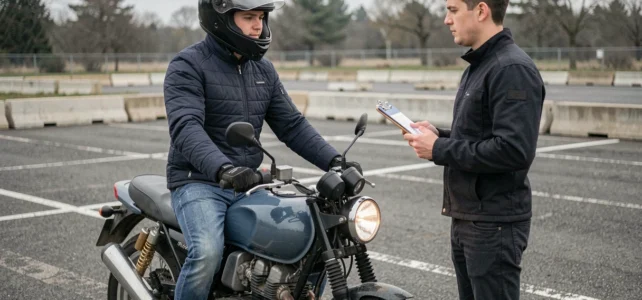
After leaving the motorcycle school with the license in hand, everything seems different on the first solo ride. The well-marked exam course on the plateau has nothing to do with a roundabout during rush hour. This gap between passing the test and mastering your motorcycle in daily life traps most new license holders. The challenge is not to start over from scratch, but to build the habits that the initial training didn’t have time to instill.
License obtained and real driving: two distinct levels of skill
On the exam plateau, we practice a calibrated slow course, an emergency stop at moderate speed, and an avoidance maneuver. These exercises validate a minimal foundation. In traffic, the demands come simultaneously: reading the road, managing the clutch during a slowdown, anticipating the behavior of a vehicle that hasn’t seen you.
The difference lies in the cognitive load. When you still have to think about shifting gears with your left foot or modulating the front brake with your right lever, there are few mental resources left to anticipate. The goal in the first months is to automate basic actions to free up attention for the road.
For those looking to learn to ride a motorcycle easily, this distinction between exam skills and real road ease is the starting point for any serious progression.
Parking exercises before riding in traffic
Revisiting basic exercises in an empty parking lot, engine off around you, remains the safest way to progress without risk. You work on an isolated action until it becomes reflexive, then move on to the next one.
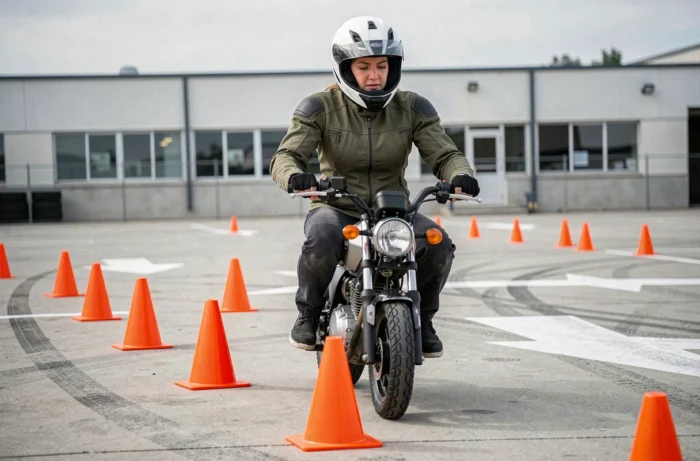
Starting, stopping, tight turn
The basic loop consists of starting, riding for about twenty meters, stopping cleanly with both brakes, and then executing a tight turn. You repeat the sequence until you no longer think about the clutch’s biting point. The tight turn, in particular, requires turning the handlebars fully while maintaining a steady throttle and looking far in the direction of exit.
Progressive emergency braking
The braking combines front and rear brakes in a precise dosage. You start gently, increasing the approach speed from session to session. A common trap: locking the rear wheel with the right foot out of panic reflex. In a parking lot, a locked wheel has no consequences. In the city, it leads to a fall.
Slalom and obstacle avoidance
Setting markers on the ground (water bottles, cones) and slaloming at reduced speed works on counter-steering and handlebar-eye coordination. Obstacle avoidance is then added: riding straight, then suddenly veering left or right at the signal of an accompanying person. These exercises develop the fine motor skills that the exam plateau only grazed.
- Repeated starting and stopping until total mastery of the biting point
- Emergency braking with progressively increasing approach speed
- Tight slalom to work on counter-steering at low speed
- Obstacle avoidance on signal to improve reaction time
Visibility on the road: don’t rely on others
A motorcyclist is less visible than a car, in all conditions. Riding with lights on at all times is not always enough. Positioning in the lane plays a direct role: riding in the left third of your lane on a two-way road allows you to appear earlier in the rearview mirror of the vehicle ahead and broadens your own field of vision.
Reflective clothing or high-visibility bands reduce the risk of being overlooked, especially at dawn, dusk, or in overcast weather. Some motorcyclists add a brief horn honk when approaching a poorly cleared intersection. Feedback varies on this point, but in areas where blind spots are common, signaling your presence with sound remains a useful defensive reflex.
Building motorcycle habits on the first rides
Once parking exercises are mastered, we move to the road, but not just any road. Choosing a short and repetitive route for the first outings allows you to focus on riding without adding the stress of navigation. A route of five to ten minutes, known in advance, that you repeat several times during the week.
Clutch management in traffic
In the city, the clutch is constantly in use. Slowing down, restarting, merging: the left hand almost never releases the lever. The reflex to instill is to downshift systematically before slowing down rather than braking while remaining in too high a gear. A motor that slows with you stabilizes the motorcycle much better than braking with only the wheel.
Look and trajectory in turns
The gaze directs the trajectory. This is the foundation taught in motorcycle school, but in real situations, the natural reflex is to fixate on the obstacle or the edge of the road. You correct this by consciously forcing your gaze towards the exit of the turn, as far as possible. After a few weeks, the movement becomes natural and the trajectory smooths out.
Motorcycle protective gear: what truly protects
A certified helmet protects the head, that’s understood. What new motorcyclists often underestimate are CE-certified gloves and high-top shoes. In the event of a low-speed fall, the hands hit the ground first. City gloves do not withstand the abrasion of asphalt.
- Certified helmet, fitted without play, chin strap fastened
- CE-certified gloves with reinforcements at the palms and joints
- Jacket with integrated back, elbow, and shoulder protections
- High-top boots covering the ankle for stability on footpegs
- Reinforced pants or motorcycle jeans with knee and hip protections
Complete gear should be worn on every ride, even short ones. Most falls occur at low speeds, close to home, on familiar routes. A reinforced jacket with back protections significantly limits chest trauma in the event of an impact, even at reduced speed.
Progressing on a motorcycle after obtaining the license takes time, a secure area to repeat actions, and a deliberately slow increase in difficulty. Habits are built ride after ride, not in a single ambitious outing on a main road. The license opens the road, but it is patient repetition that makes it safe.