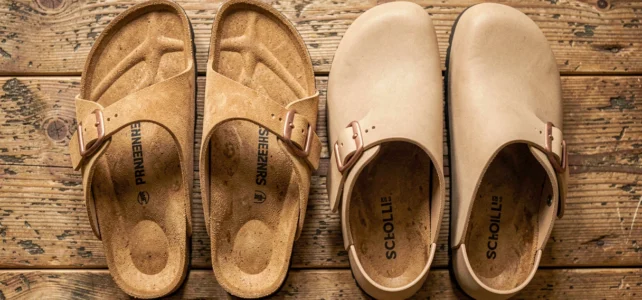
Scholl and Birkenstock share a promise of orthopedic comfort, but their soles do not meet the same biomechanical constraints. Comparing these two brands is akin to measuring two distinct philosophies: immediate relief on one side, progressive structural support on the other. The choice depends less on aesthetic preference than on foot morphology, walking style, and the level of support sought.
Scholl and Birkenstock comparison: sole, materials, and fit
| Criteria | Scholl | Birkenstock |
|---|---|---|
| Origin | United States, 1906, founded by a doctor | Germany, 1774, shoemaking tradition |
| Type of sole | Soft anatomical sole, quick cushioning | Cork and latex sole, rigid support |
| Initial sensation | Comfort felt from the first wear | Stiffness at first, progressive comfort after breaking in |
| Available widths | Single standard width on most models | Two footbed widths: normal and narrow |
| Signature materials | Wood, leather, synthetic depending on the range | Natural cork, leather, suede, recycled materials |
| Positioning | Medical ergonomics, functional relief | Durable anatomical support, fashion and outdoor |
This table highlights a structural gap. Scholl prioritizes flexibility and accessibility, while Birkenstock focuses on the durability of cork and a finer morphological fit. To delve deeper into the specifics of each brand, a detailed guide allows for comparison of Scholl vs Birkenstock to make the right choice based on personal criteria.

Narrow feet, bunions, pronounced arches: which brand for which morphology
The shape of the foot remains the most often overlooked parameter at the time of purchase. The two brands do not cover the same podiatric needs, and the wrong choice can exacerbate existing discomfort.
Narrow and slim feet
Birkenstock offers two footbed widths, normal and narrow, which prevents narrow feet from floating in the sandal. The narrow version reduces lateral space and improves heel stability. Scholl, with a standard width on most of its models, is more suitable for medium-width feet. A very narrow foot in a classic Scholl may compensate by tensing the toes.
Bunions
Bunions require a wide fit at the forefoot and lateral support without pressure. Birkenstock’s open models, like the Arizona, leave the metatarsal joint free while stabilizing the arch with cork. Scholl offers open mules (like Pescura) that relieve the sensitive area, but the lateral support is less structured than on a molded cork footbed.
Highly pronounced arches
A high arch requires firm midfoot support. Birkenstock’s cork sole gradually conforms to the curvature of the foot after a few days of breaking in, and the support adapts to individual morphology. Scholl provides more immediate cushioning but less personalized support over time. For a very arched foot, Birkenstock offers durable support that Scholl compensates for with initial flexibility.
Immediate comfort from Scholl or long-lasting support from Birkenstock: how usage changes the choice
The context of use determines the choice as much as morphology. Scholl and Birkenstock do not address the same question: relieve now, or support the foot over thousands of steps.
- Prolonged standing (health professions, hospitality, retail): Scholl, with its soft sole and immediate cushioning, reduces fatigue felt from the first hours. The foot is relieved without a break-in period.
- Long-distance walking (tourism, light hiking, daily urban commutes): Birkenstock, thanks to the cork that conforms to the foot, offers support that improves over time. The initial stiffness disappears after breaking in, and arch support remains stable over several kilometers.
- Domestic or occasional use: both brands are suitable, but Scholl stands out for a frictionless start, while Birkenstock requires a few days to reach full comfort.
This distinction between functional relief and structural support explains why some users own both brands for different contexts.

Birkenstock cork sole and Scholl wood sole: durability and maintenance compared
The natural cork used by Birkenstock compresses slowly to conform to the footprint of the foot. This controlled deformation is both the main advantage (gradual personalization) and the limitation of the material: once the cork is compressed beyond a certain threshold, support decreases. Birkenstock recommends replacing the insole rather than the entire pair, which extends the product’s lifespan.
Scholl uses wood on some iconic models (Pescura range) and synthetic materials on other lines. Wood offers stable rigidity over time but does not adapt to individual morphology. Synthetic soles lose their cushioning more quickly than cork.
In terms of maintenance, Birkenstock cork requires occasional moisturizing treatment to prevent drying and cracking. Scholl wood models require little care, but synthetic versions do not withstand prolonged exposure to moisture well.
Flagship models of Scholl and Birkenstock: benchmarks to guide the choice
At Birkenstock, the Arizona remains the reference in open sandals with two straps. Its availability in normal and narrow widths makes it the most versatile model to test the brand. The Boston, closed at the front, is suitable for transitional seasons and feet sensitive to cold.
At Scholl, the Pescura mules embody the brand’s DNA: wooden sole, single strap, immediate comfort. The brand has also expanded its range to include fashion collaborations (notably with Céline), which sometimes blurs the lines between medical positioning and lifestyle positioning.
The final choice rests on three variables: foot width, dominant activity type, and tolerance for a break-in period. A narrow foot with a high arch will find more answers with Birkenstock. A standard foot seeking quick relief without adaptation will naturally turn to Scholl. Morphology decides where style hesitates.