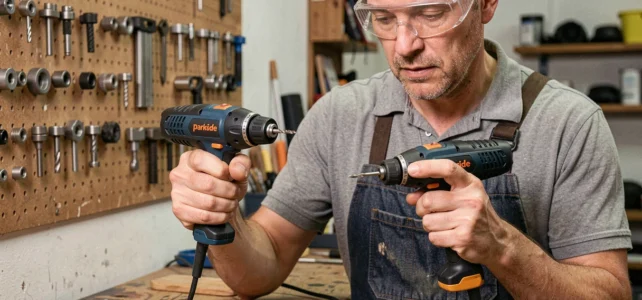
You spotted a Parkside rotary tool on sale at Lidl and you’re hesitating between it and a Dremel. The displayed price tips the scales, but doubts remain about the actual quality. These two brands do not operate in the same category, and the difference is not just about the price tag.
Parkside and Dremel: two opposing industrial logics
Parkside is Lidl’s own brand. Its tools are designed for occasional domestic use, sold during specific promotional events. Once the stock is depleted, the model sometimes disappears from the shelves for months.
Dremel belongs to the Bosch group. Its ranges remain in the catalog permanently, at many retailers. This continuous presence ensures lasting access to spare parts and compatible accessories.
This distinction has a direct consequence on your purchase. A Parkside bought in 2024 may become difficult to equip with specific accessories two years later. A Dremel 4000, on the other hand, remains stocked with consumables at any tool distributor. A detailed guide on the differences between Dremel and Parkside from Lidl helps to better understand this reality before making a choice.
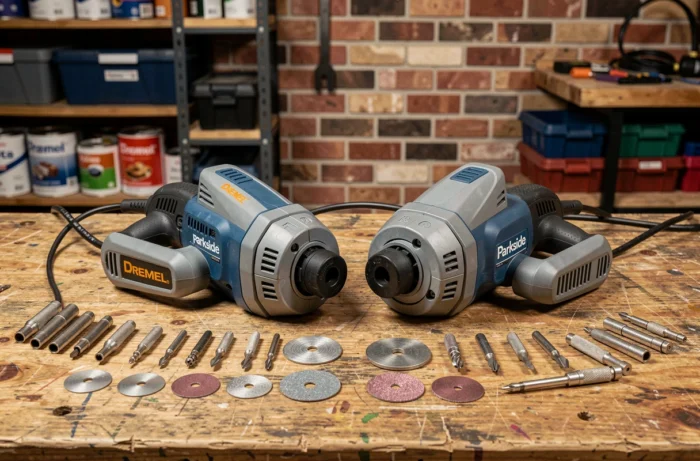
Actual reliability of a Parkside rotary tool after one year of use
The immediate performance of a Parkside is often acceptable. The problem lies elsewhere: reliability drops after a few hundred hours of use.
User feedback and recent after-sales analyses point out recurring weaknesses:
- Battery chargers are the component that fails most often after one to two years, well before the machine itself.
- On the Parkside Performance ranges, the actual torque measured is lower than the values announced by the manufacturer.
- The chuck and electronics show signs of fatigue after regular and sustained use.
Have you ever noticed abnormal vibrations on a new tool? This is a defect reported repeatedly on certain Parkside models. Several users have reported having to return their tool on the same day of purchase for this reason.
Dremel shows significantly higher mechanical consistency over time. The quality of the bearings, the precision of the chuck, and the electronic stability remain reliable even after prolonged intensive use.
Warranty and after-sales service: the true hidden cost of a cheap tool
Parkside offers a warranty, but the after-sales process goes through Lidl. In practice, this means a return to the store, an exchange if the product is still in stock, or a store credit otherwise. No network of authorized repairers or dedicated technical support.
Dremel operates with the Bosch network. The warranty generally covers two years. You have access to a structured after-sales service with diagnostics, repairs, or replacements. For a tool you plan to keep for several years, this difference is significant.
Availability of accessories over time
A rotary tool without suitable accessories loses all its appeal. Cutting discs, sanding tips, or precision chucks must remain available.
At Parkside, accessory sets are sold during the same promotional events as the machines. Outside of Lidl’s sales period, finding a compatible consumable becomes a real challenge. Some Dremel accessories fit, but not all, and compatibility is never guaranteed by the manufacturer.
At Dremel, the accessory catalog is standardized and permanent. You can find what you need at hardware stores or online, at any time of the year.
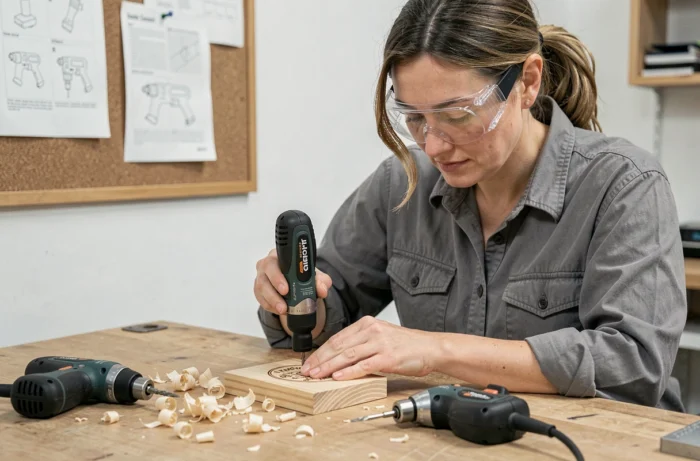
Parkside or Dremel rotary tool: for what type of work
Why does this choice matter so much? Because the rotary tool is used for very different tasks depending on the users. Sanding a model part, cutting a rivet, engraving glass, cleaning rust: each use puts different demands on the machine.
For occasional and light use, Parkside fulfills its role. You pull out the tool once a month for a small adjustment, and it will do the job without any issues for a while.
However, as soon as the use becomes regular (modeling work, furniture restoration, frequent small precision tasks), the limitations of Parkside quickly become apparent. The consistency of the rotation speed, the precision of the grip, and the comfort during long sessions clearly favor Dremel.
The real value for money, beyond the receipt
The purchase price of a Parkside is significantly lower. A complete set costs a fraction of the price of a Dremel 4000 equipped. This is a valid argument if you’re looking for a disposable tool for a one-off job.
But if you add the potential replacement of the charger, the repurchase of hard-to-find accessories, and the risk of premature failure, the total cost of ownership of a Parkside sometimes approaches that of a Dremel. A well-maintained Dremel lasts easily five to ten years. A Parkside rarely exceeds two to three years with regular use, according to community feedback.
The choice boils down to a simple question: are you buying a tool for an immediate and limited need, or are you investing in durable equipment? The answer leans towards Parkside in the first case, towards Dremel in the second. Neither is a bad product, but they do not cater to the same user profile or usage horizon.