
When an industrial SME with 40 employees connects an artificial intelligence tool to its ERP to anticipate stock shortages, it is not engaging in foresight. It is solving a concrete problem: avoiding production line stoppages and emergency orders that erode its margins. It is through these types of real-world cases that AI is truly entering French companies, far from the rhetoric about technological revolution.
Automation of repetitive tasks: where AI changes daily life
We often talk about productivity in abstract terms. In practice, the gain is measured by the stack of tasks that an employee no longer needs to do manually. Invoice reconciliation, sorting incoming emails, extracting data from delivery notes: these operations still consume hours each week in many organizations.
AI automation tools operate on a simple principle. A model is trained on the company’s existing data, and then it reproduces the classification or data entry decisions that a human would have made. The real gain lies in high-volume, low-variability tasks, not in complex cases that require judgment.
Feedback on this point varies by sector: a logistics company processing thousands of order lines per day will see an immediate effect, while a consulting firm with all different cases will derive less benefit from raw automation. Specialized platforms like botagora.fr are specifically designed to assist in identifying processes with high automation potential.
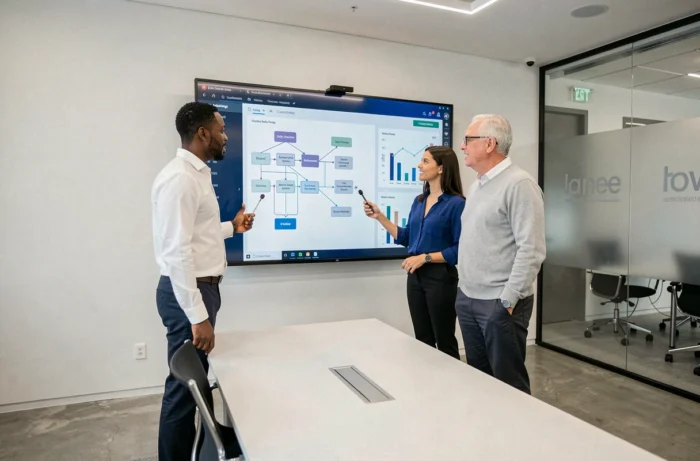
Generative AI in business: beyond text writing
Generative AI was initially perceived as a content production tool. In practice, the most profitable uses are found elsewhere.
Document synthesis and data analysis
A quality manager who needs to compile 200 pages of audit reports to extract recurring non-conformities can now delegate this task to a model. Document synthesis significantly reduces the preparation time for management reviews.
Internal data analysis, when well-framed, also allows for the identification of trends that no one had the time to search for. A sales director can query their sales data in natural language instead of going through an analyst or manipulating pivot tables.
Code generation and prototyping
Technical teams use generative AI to produce functional code on standardized software components. This is not about replacing a developer, but about preventing them from rewriting an API connector or data entry form for the hundredth time. The prototyping of internal applications, which used to take several weeks, can now be completed in a few days.
Adoption of AI by French SMEs: a persistent gap
The figures from Insee are telling. In France, the share of companies with 10 or more employees using AI has increased from 6% in 2023 to 18% in 2025, tripling in two years. The momentum is real.
The reality behind this average hides a structural imbalance. In 2025, 58% of companies with 250 or more employees report using at least one AI technology, compared to only 15% of companies with 10 to 49 employees. User companies account for about two-thirds of the revenue in the studied scope.
This is not a matter of will. SMEs face three concrete obstacles that hinder their action:
- The lack of structured and usable data, because information systems were not designed to feed AI models
- The absence of internal skills to assess, deploy, and maintain the tools, creating total dependence on service providers
- The actual integration cost, often underestimated, which includes data cleaning, team training, and adapting existing processes

Integration of AI and data governance: the real challenge
Deploying an AI tool without addressing data quality is like installing a GPS in a car without wheels. We regularly see pilot projects abandoned after a few months because the model produced aberrant results, fed by inconsistent or incomplete databases.
The preliminary task, the one that no one wants to fund, is organizing the information system. This involves very concrete actions:
- Harmonizing product, client, and supplier references across the different software used
- Establishing data entry rules that ensure the consistency of new data
- Defining who has access to what, with what level of confidentiality, in compliance with GDPR
- Documenting the deployed models so that their functioning remains understandable by business teams
Without data governance, AI amplifies errors instead of correcting them. A predictive model fed by poorly categorized sales histories will produce unusable forecasts, regardless of the budget invested in technology.
Training employees, not just convincing them
Training is not limited to a half-day awareness session. Employees who will use the tools daily need to understand what the model does, what it does not do, and when they need to take control. AI makes better decisions when humans know when not to trust it.
Companies that succeed in their integration are those that identify AI referents in each department, capable of linking operational needs with technical possibilities. This translation role is as crucial as the choice of the tool itself.
Artificial intelligence does not transform a company merely by its presence. It produces measurable results when it relies on clean data, well-identified processes, and teams trained to use it wisely. The tripling of the adoption rate in France shows that the movement has begun, but the majority of SMEs are only at the beginning of the journey.