
When maintaining an aquarium at home with children, the question of monitoring quickly arises: who fed the fish this morning, when was the last water change, what is that striped fish bought at the pet store three months ago? A dedicated fish monitoring notebook solves these practical problems. It centralizes observations, distributes tasks, and transforms aquarium maintenance into a shared activity.
Fish Monitoring Notebook: What We Really Note Daily
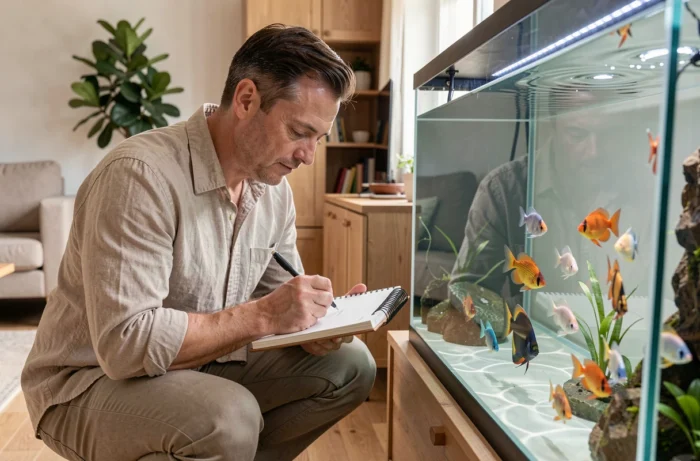
A monitoring notebook doesn’t need to resemble a scientific register to be useful. It first records routine maintenance actions: date of the last water change, amount replaced, filter cleaning. This information may seem trivial, but it becomes valuable when a problem arises (sudden algae, lethargic fish).
The most interesting part for children concerns direct observation of the fish. We note behavior, interactions between species, the appearance of new colors in a juvenile. A child who draws a guppy in the notebook remembers the species name better than by reading a fact sheet.
On the parameters side, we can simplify things. Morning temperature reading, pH or nitrate test results when we do one: no need for a complex table. A regular, even basic, monitoring is better than a detailed record abandoned after two weeks.
Some families looking to structure this monitoring use the family feature on My Fish Book, a tool that allows sharing observations among several household members without multiplying supports.
Distributing Aquarium Tasks Between Parents and Children
The notebook becomes an organizational tool as soon as we add a “who does what” column. We assign feeding to one child, temperature readings to another, partial water changes to the available parent on the weekend. Each family member has a visible and traceable responsibility.
With young children, we adapt the level of detail. A “fish fed” pictogram to color is enough for a five-year-old. Older kids can write a complete observation and check the water parameters.
When the Notebook Prevents Common Mistakes
Double feeding is probably the most frequent problem in a household with several people around an aquarium. The fish receives its ration twice because no one checked if someone had already taken care of it. A notebook placed next to the tank, with the date and initials of the person who fed, eliminates this error.
The other common trap concerns treatments. If a product is administered against white spots, we need to know when the treatment started, what dose was given, and when to renew. Without written records, we either overdose or stop too early. The notebook protects both the fish and the parents’ peace of mind.
Paper Notebook or Aquarium Monitoring App: What to Choose as a Family
The paper notebook has an obvious advantage: it requires no screen, no connection, no password. It can be placed near the aquarium, and everyone can open it. For families wanting to limit children’s screen time, this is a strong argument.
Apps offer other benefits. Some, like Traces de pêche, allow family sharing for up to six members and work entirely offline. Others, focused on aquaristics, provide automatic reminders for maintenance and graphs of water parameter changes.
- The paper notebook is suitable for families with young children: drawings, coloring, free writing, handling without risk of breakage
- A shared app works better when family members are not always in the same place (separated parents, independent teenagers)
- The combination of both (paper notebook for daily observations, app for long-term history) yields the best results for sustainable monitoring
Feedback varies on this point: some families abandon the app after a few weeks because data entry takes too long, while others find the paper notebook too easy to forget. The best support is the one that the whole family actually uses.
Transforming the Notebook into an Educational Tool for Children
A family aquarium is a natural learning ground: biology, water chemistry, species geography. The notebook allows formalizing these discoveries without turning it into a lesson.
Building a Personal Picture Dictionary of Species
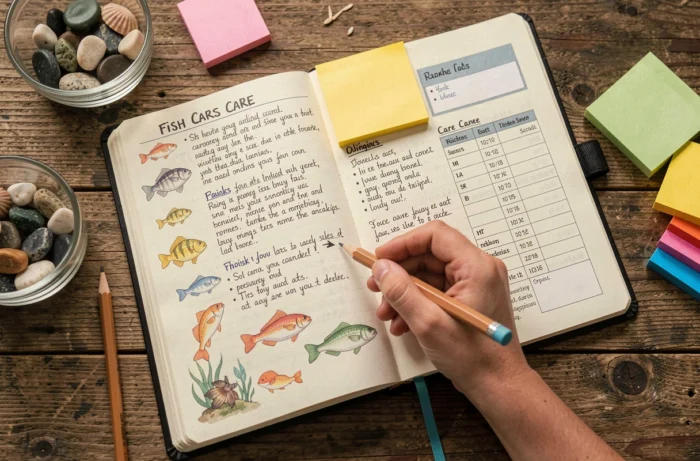
We reserve a page for each species present in the tank. The child glues or draws the fish, notes its common name and scientific name, its geographical origin, and its diet. Over the months, the notebook becomes a picture dictionary of aquatic animals created by the child themselves.
This approach aligns with practices used in certain educational tools on the ocean theme, designed for children to learn through active observation rather than passive reading.
Linking the Aquarium to Resource Management Issues
For older children, the notebook can incorporate concepts of resource management. Recent regulations on reporting recreational fishing catches at sea show that monitoring and traceability are not reserved for professionals. Explaining to a teenager why we note water parameters or why we don’t overcrowd a tank transmits a logic of respect for the ecosystem that they will encounter in other contexts.
- Observing and noting a fish’s behavior develops patience and attention to detail
- Measuring pH or temperature introduces concrete notions of chemistry and physics
- Managing a maintenance budget (food, filters, treatments) familiarizes with planning
A fish monitoring notebook requires neither special skills nor heavy investment. A spiral notebook, a pencil, and a bit of regularity are enough for the family aquarium to transition from decoration to a shared project. The hardest part is not starting, but maintaining it beyond the first month, and this is exactly where the collective aspect makes a difference.