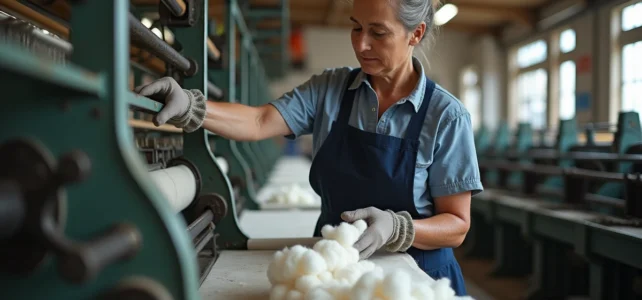
The production of a textile fabric involves a chain of transformations where each step conditions the next. From raw fiber to a roll of fabric ready for making, the journey goes through spinning, weaving or knitting, and then finishing. Each of these phases relies on technical choices that determine the quality, durability, and feel of the finished product.
Dyeing yarn before weaving: a game-changing production choice
Most content describes dyeing as a final operation, applied to the already formed fabric. This classic sequence masks an increasingly common alternative in the industry: dyeing yarn, done before weaving (a process known as yarn-dyed).
The principle is to dye the cotton, polyester, linen, or viscose yarn upstream, then dry and inspect it before sending it to the loom. The resulting fabric has more stable colors when washed because the pigment penetrates the fiber deeply rather than remaining on the surface.
This yarn-dyed process adds additional quality control steps between spinning and weaving. It lengthens the production cycle and increases the unit cost. However, it reduces losses related to late dyeing defects, when an entire batch of fabric must be rejected due to a non-compliant shade. This choice is described in detail in the fabric manufacturing process on Boulevard Mode, which outlines the sequence of these operations.
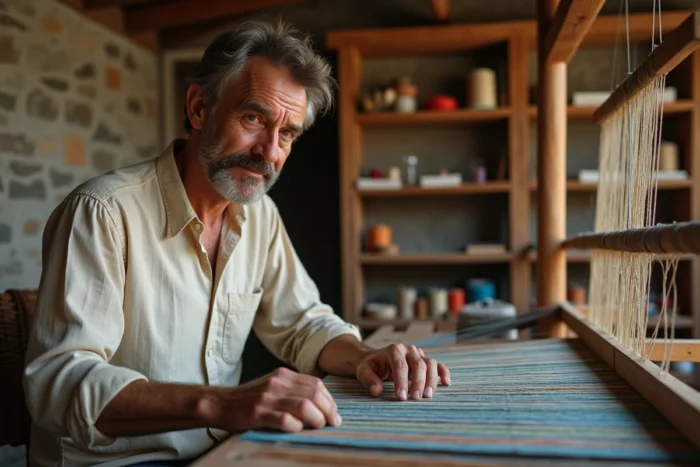
Selection of textile fibers and spinning: the foundation of the entire chain
It all starts with the raw material. Fibers are divided into two main families: natural fibers (cotton, linen, wool, silk) and chemical fibers, which are further divided into artificial (viscose, lyocell) and synthetic (polyester, nylon). This initial choice guides all production parameters.
Spinning transforms these fibers into usable yarn. The process differs radically depending on the nature of the material:
- Short natural fibers (cotton, linen) go through carding, drawing, and then twisting to form a continuous yarn from discontinuous elements.
- Chemical fibers are extruded as continuous filaments, and may then be cut and twisted to mimic the behavior of natural fibers.
- Silk, a special case, is unwound directly from the silkworm cocoon as a single filament, and then several strands are combined to obtain a yarn of sufficient thickness.
The quality of the yarn conditions everything that follows. Poorly twisted or irregular yarn will cause visible defects in the finished fabric, and no finishing operation can correct them.
Weaving and knitting: two approaches to fabric construction
Once the yarn is ready, the actual construction of the textile begins. The two dominant processes, weaving and knitting, produce fabrics with very different properties.
Weaving on a loom: warp and weft threads
Weaving interlaces two sets of perpendicular threads on a loom. The warp threads are stretched lengthwise, while the weft threads pass transversely. The method of interlacing defines the weave: plain, twill, or satin. Plain weave produces a stable and durable fabric. Twill creates visible diagonals (as in denim). Satin produces a smooth and shiny surface, but is more fragile.
The tension of the warp threads during weaving plays a direct role in the uniformity of the fabric. A poorly calibrated adjustment causes areas of variable density, perceptible to the touch as well as to the eye.
Knitting: loops for elasticity
Knitting forms the fabric by interlacing loops (stitches) rather than crossing threads. The result is a naturally stretchy textile, used for close-fitting garments, hosiery, or elastic technical textiles. A knit does not have warp and weft in the classical sense, which gives it mechanical properties distinct from woven fabric.
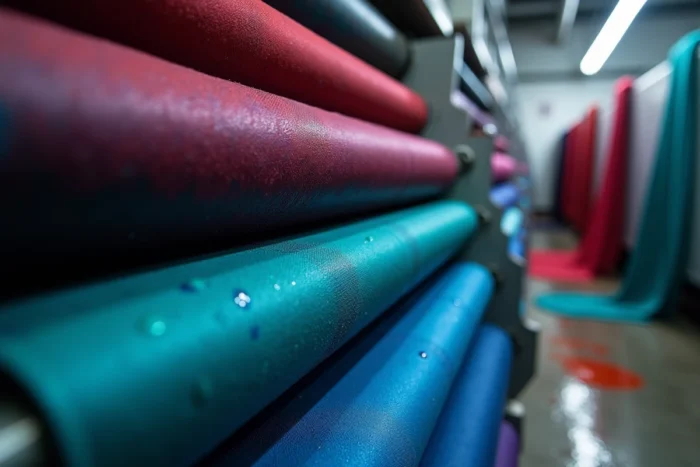
Finishing and treatments: the processes that define the final use
The raw fabric coming out of the loom or knitting machine is not directly usable for making garments or textile items. It goes through a finishing phase that includes several operations:
- Desizing and washing remove the products applied to the yarn to facilitate weaving (glues, waxes, temporary finishes).
- Dyeing (when it has not been done on yarn) and printing add color and patterns.
- Functional treatments provide specific properties: wrinkle resistance, water repellency, anti-pilling, or shrinkage control.
- Calendering, brushing, or embossing modify the feel and surface appearance.
These finishes are not cosmetic. An unrefined fabric may shrink, deform, or discolor after the first wash.
Non-woven textiles: a parallel sector often overlooked
Content on textile manufacturing focuses on weaving and knitting. However, a third industrial path is increasingly significant: the production of non-woven textiles, which does not involve weaving or knitting.
The manufacturing follows four standardized phases: selection and preparation of fibers, formation of a web, bonding this web through chemical, thermal, or mechanical means, and then finishing and converting into a finished product. Applications cover medical (masks, gowns), geotextiles, industrial wipes, and filtering materials.
This sector does not produce fabric in the traditional sense, but it uses the same starting fibers (polyester, polypropylene, cotton) and shares part of the logistics chain with the traditional textile industry. Field reports diverge on the durability of these non-woven products compared to woven ones, particularly because their target uses (disposable versus durable) are not the same.
The production of textile fabrics remains a sequence of interdependent technical decisions. A low-quality yarn will never yield a good fabric, and a good fabric that is poorly finished will not meet expectations in use. Understanding these steps allows for a better assessment of the quality of a textile, whether for garment making or for technical applications.