
A dishwasher for 12 place settings consumes an average of 141 kWh per year according to ADEME. This figure, often quoted as is, masks considerable discrepancies between models, programs, and loading habits. Optimizing the electrical consumption and kWh of your dishwasher relies less on generic actions and more on a fine understanding of the thermal functioning of the device and the pricing framework in which it operates.
Heating element and power profile: the neglected aspect
The heating element accounts for almost all of the electrical consumption of a cycle. In a standard program at 60 °C, the water temperature rise absorbs more than 80% of the energy of the cycle. The circulation pump motor and control electronics only account for a few dozen watts in comparison.
We regularly observe that users compare programs based on their duration, while the determining parameter is the set temperature. A short cycle at 65 °C consumes more than an eco cycle of two hours at 50 °C, because the latter compensates for the reduced temperature with a longer soaking time and extended mechanical action.
To better understand the electricity consumption and kWh of the dishwasher, it is necessary to distinguish between peak power (used during heating, often between 1,800 and 2,400 W) and the average power over a complete cycle, which is significantly lower. It is this average power, multiplied by the duration, that gives the actual kWh.
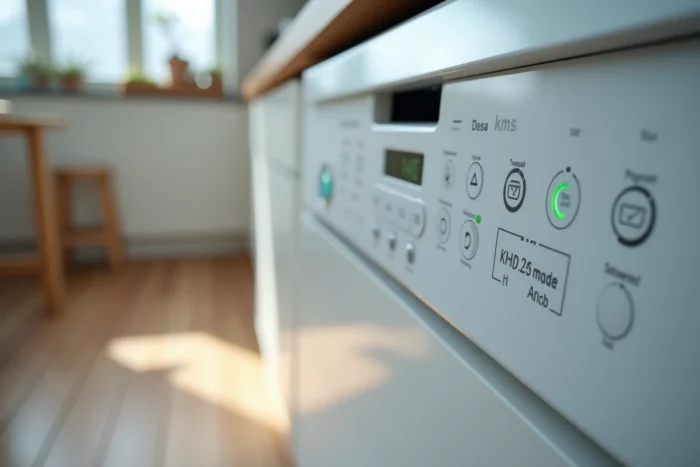
New energy label A-G: reading the product sheet beyond the class
Since March 2021, the European label has abandoned the old A+++ to D system in favor of a recalibrated A to G scale. The most efficient dishwashers are now in class A or B, with typical annual consumption around 90 to 150 kWh for 280 reference cycles.
This overhaul has made visible discrepancies that the old label obscured. A device rated C on the new scale often corresponds to an old A++ or A+. In practical terms, moving from a model rated D or E to a model rated B significantly reduces the annual bill related to the dishwasher.
What the product sheet reveals about consumption per cycle
The European product sheet indicates the kWh consumption of the eco program, not the standard program. The eco program serves as a regulatory basis for comparing devices with each other. If you primarily use the intensive or quick program, your actual consumption will exceed the value displayed on the label.
We recommend consulting the complete product sheet (available from the manufacturer) which also details the consumption of the standard program. The gap between the eco program and the standard program commonly reaches an additional 30 to 40% of kWh.
Off-peak hours and delayed programming: an underutilized pricing lever
In full/partial hours pricing, the price of kWh varies according to the time slot. Programming the dishwasher to start during off-peak hours (usually at night) reduces the cost of each cycle without changing the kWh consumption.
The financial gain depends on the difference between the two rates in your contract. On a classic HP/HC subscription, the difference is sufficient for the systematic postponement of the cycle to off-peak hours to represent a notable annual saving, especially if you run the appliance daily.
- Check the time slots for your off-peak hours on your bill or via your Linky meter (they vary by municipality and may not be contiguous).
- Use the built-in delayed start function on your dishwasher rather than an external programmable socket, which does not interact with drying cycles.
- Avoid starting the cycle just before the end of off-peak hours: an eco program often lasts more than two hours, and the heating phase (the most consuming) must take place entirely at the reduced rate.
Eco cycle vs. quick cycle: what the kWh reveal
The quick cycle, often presented as economical because it lasts 30 to 45 minutes, is an energy trap. A short cycle heats the water faster and to a higher temperature, which keeps the heating element at full power for a larger proportion of the total time.
The eco program, on the other hand, uses a reduced washing temperature (around 50 °C) and compensates with an extended cycle duration. The consumption per cycle then drops significantly below that of a standard or quick program. A well-rated recent dishwasher for 14 place settings runs around 0.54 to 0.9 kWh per cycle in eco mode, compared to more in intensive mode.
When the eco program is not enough
On very greasy dishes or gratin dishes, the eco program may leave residues. Restarting a second cycle cancels out all the energy savings. In this case, a single well-suited standard cycle consumes less than two eco cycles.
The best practice is to reserve the intensive program for genuinely necessary cases and to use the eco program as the default cycle. Regular descaling of the machine (depending on the hardness of the local water) maintains the thermal efficiency of the heating element and avoids having to compensate with a higher temperature.

Optimal loading and filter maintenance: two measurable parameters
Running a dishwasher half full mechanically doubles the energy cost per place setting. Full loading remains the most direct optimization lever on annual consumption.
- Always load the lower basket before the upper one: the washing arms cover larger items placed below more effectively.
- Clean the bottom filter weekly if you use the appliance daily: a clogged filter reduces the pump flow, lengthens the cycle, and increases consumption.
- Check the washing arms: a hole blocked by food debris alters the pressure of the jets and degrades washing efficiency, leading to the selection of a more energy-consuming program.
A well-maintained appliance retains its original energy performance throughout its lifespan. In contrast, a neglected dishwasher sees its actual consumption gradually drift above the values indicated on the label, sometimes substantially after a few years.
The combination of eco program, off-peak hours, and full loading constitutes the most effective optimization trio. None of these three levers taken in isolation produces spectacular results, but their cumulative effect over a full year of daily cycles translates into a tangible reduction in the washing-related bill.