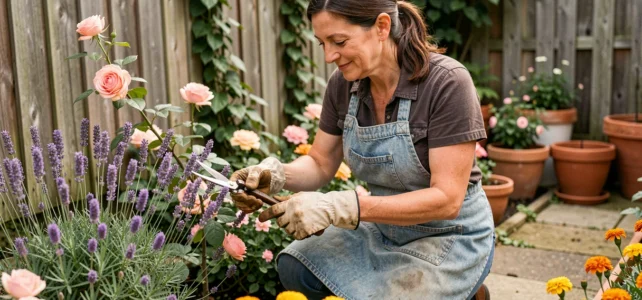
A flowering garden all year round relies less on the number of species planted than on mastering the flowering relay and adapting the soil to each plant layer. Popular articles pile up lists of plants by season without addressing the technical constraints that cause most mixed borders to fail: edaphic compatibility, management of root competition, and especially resilience to drought episodes that have redefined varietal choices in recent years.
Drought-tolerant perennials: the new structural base of a flowering border
The selection of perennials for a continuously flowering garden has changed profoundly. Gauras, Buenos Aires verbena, autumn sedums, ornamental sages, yarrow, and coreopsis are now recommended not only for dry gardens but as the backbone of family borders in any region. These species cover a flowering window from May to the first frosts while withstanding watering restrictions.
We recommend establishing the framework of the border with these long-flowering perennials, then filling in seasonal gaps (winter, early spring) with bulbs and a few decorative wood shrubs. This approach reverses the classic logic that started with roses and annuals to “complete” later.
To delve deeper into plant associations and find composition ideas by season, you can consult the garden of Le Blog de Coco, which details several palettes adapted to current constraints.
Root competition and edaphic compatibility in mixed borders
Placing perennials, bulbs, and shrubs side by side without considering their root requirements is the primary cause of failure for a border intended to flower all year round. Each plant layer has an underground behavior that conditions the success of its neighbors.
Yarrow and ornamental sages develop a shallow and spreading root system. Planting them at the foot of a deep-rooted shrub (like a dogwood or a mahonia) works. However, associating two perennials with spreading roots in the same square meter causes water competition that weakens both plants, especially during dry periods.
The soil acts as a filter. A clay-limestone substrate will suit yarrow and coreopsis but will suffocate winter heathers. Before any planting, we observe that a simple pH test and an analysis of soil texture (sandy, loamy, clayey) can eliminate the most common casting errors.
Three neighborhood rules to follow
- Separate spreading perennials (gaura, yarrow) from competitive ground covers (lamium, bugle) with a buried border or a minimum spacing of 40 cm
- Position bulbs (daffodils, crocuses, autumn colchicums) between deciduous perennials whose foliage disappears in winter, to exploit available light without leaf competition
- Reserve the most draining areas of the border for sages and sedums, and the cooler pockets for astilbes or heucheras that ensure color relay in partial shade
Flowering calendar by layer: organizing relays without gaps
A flowering garden all year round is managed like a cultivation schedule, not like a collection. We structure the relays into three complementary layers: shrub, perennial, and bulbous. Each layer covers different months, and it is their overlap that eliminates empty periods.
The shrub layer ensures winter presence. Mahonias bloom from December to February, witch hazels from January to March, and colored wood dogwoods provide visual structure even without leaves. These species only require light pruning after flowering.
The perennial layer takes over from March with hellebores, gains momentum with perennial geraniums and nepetas in May, then shifts to sages, gauras, and echinaceas until October. Autumn sedums close the perennial season by ensuring the transition to winter shrubs.
The bulbous layer fills in the gaps. Snowdrops and crocuses open the year as early as February, daffodils and botanical tulips cover March-April, alliums take May, and colchicums reappear in September-October. A properly planted bulb border leaves no month without a splash of color at ground level.
Maintenance without synthetic phytosanitary products: regulatory framework and alternatives
Since January 1, 2019, individuals are no longer allowed to buy, use, or possess synthesized phytopharmaceutical products, whether for vegetable gardens or ornamental borders. This ban particularly concerns chemical herbicides for paths and flowering borders.
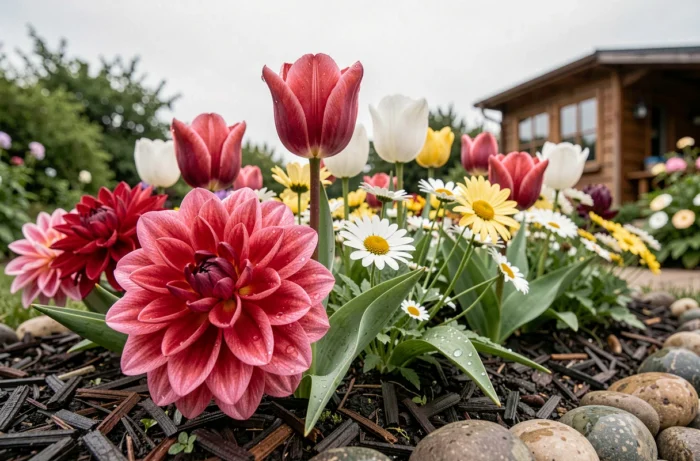
In practice, this forces a rethink of weed management in borders. Organic mulching (wood chips, hemp flakes) remains the most effective solution: it limits the emergence of unwanted grasses, retains soil moisture, and nourishes microbial life as it decomposes.
- Mulch to a sufficient thickness right after planting, avoiding covering the crowns of perennials
- Manually weed perennial weeds (bindweed, couch grass) before they establish in the root system of cultivated plants
- Use plant extracts (nettle, horsetail) as a preventive measure against fungal diseases on roses or asters susceptible to powdery mildew
Mulching replaces both chemical weeding and part of the watering, making it the most cost-effective maintenance gesture for a lasting flowering garden.
Maintaining a garden in bloom twelve months a year does not require a catalog of plants but a planting architecture designed by layer and by month. Drought-tolerant perennials form the backbone, bulbs fill the transitions, and shrubs hold the winter. The rest is just observation and adjustments throughout the seasons.