
The European market for interior decoration is undergoing a silent transformation. Sustainable, recycled, and local materials are gaining ground in catalogs as well as in buyers’ expectations. The European regulation ESPR, which came into effect in July 2024, gradually imposes eco-design requirements on furniture sold in the EU.
Transforming your interior into a unique space is no longer just about choosing a color palette or a decorative style: the origin of materials and their traceability now weigh in the equation.
Eco-design of furniture: what the ESPR regulation concretely changes
The ESPR regulation is not only about electronics or textiles: furniture is gradually being integrated into eco-design requirements. Manufacturers will need to document the origin of materials, the durability of the product, and its ability to be repaired or recycled.
The digital product passport (DPP), whose European infrastructure is set to be operational by 2026, will make this information accessible to consumers. Specifically, before purchasing a coffee table or a sofa, it will be possible to consult its exact composition, its place of manufacture, and its potential for circularity.
In France, the furniture sector is already subject to extended producer responsibility, with eco-organisms and a producer identifier (IDU). The modulations related to eco-design are strengthening. For those looking to transform their interior, this means that a well-traced piece of furniture today will retain its value better tomorrow. Documented second-hand pieces and brands that are transparent about their supply chains gain a structural advantage.
Resources like maisonmania.fr allow you to follow these developments and find decor inspirations that incorporate this dimension of sustainability.
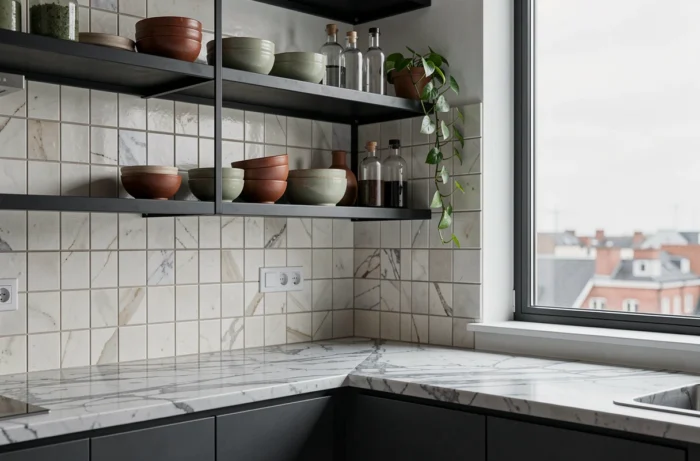
Recycled materials and reuse: beyond decorative trends
Reuse in interior decoration goes beyond mere aesthetic gestures. The vintage and second-hand furniture market is experiencing growth driven by two factors: budget constraints and the search for authenticity. A thrifted dresser has a different character than a factory-made piece, and that’s precisely what creates a unique space.
Field reports diverge on the actual quality of industrially recycled furniture. Some eco-friendly brands offer panels made from reclaimed wood, but density and longevity vary depending on the processes. Checking the certification and thickness of the material remains the most reliable precaution before a purchase.
Concrete criteria for evaluating sustainable furniture
- The presence of a producer identifier (IDU) on the label, mandatory in France for new furniture, ensures that the manufacturer contributes to the recycling chain
- Mechanical assemblies (screws, dowels) are repairable, unlike permanent adhesives that condemn the furniture in case of breakage
- Certified solid wood or E1-rated particle board (low formaldehyde emission) protects indoor air quality, a point increasingly monitored by French regulations on healthy buildings
Favoring detachable assemblies facilitates repair and reuse. This is a more decisive selection criterion than surface finish, which can always be reworked.
Indoor air quality: the invisible parameter of decoration
Transforming a space also involves what is not visible. Volatile organic compounds (VOCs) and formaldehyde emitted by certain new furniture, paints, or flooring degrade indoor air quality.
When rearranging a room (living room, bedroom, kitchen), the period following the installation of new furniture or fresh paint is the most critical. Ventilating abundantly during the first weeks limits exposure to the most concentrated pollutants at this stage.
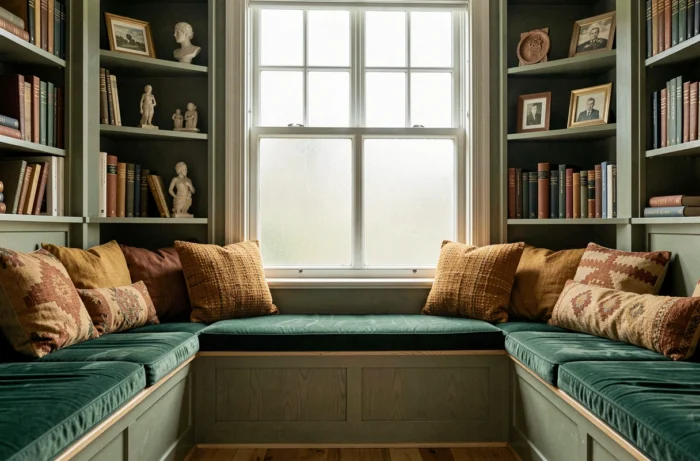
Material choices and their impact on a room’s air
Low-VOC paints are available in price ranges comparable to traditional paints. Labels like the A+ rating for indoor air emissions, mandatory in France, provide a reliable benchmark. For flooring, mineral materials or raw wood emit less than low-quality laminates.
This parameter directly relates to design: a room decorated with healthy materials does not impose aesthetic compromises. Linen, terracotta, polished concrete, or solid oak offer a palette of textures that structures an interior with character.
Natural and artificial light: structuring the atmosphere of a living room or bedroom
Light remains the most underestimated lever of transformation relative to its cost. Multiplying light sources in a living room (reading lamp, central pendant, indirect lighting behind a piece of furniture) radically changes the perception of space without touching the walls or furniture.
In contrast, natural light depends on architectural constraints. Maximizing its entry involves concrete decoration choices:
- Light linen curtains filter without blocking, whereas thick synthetic sheers absorb a significant amount of brightness
- A mirror placed opposite a window redistributes light into the depth of the room, a simple optical principle but rarely applied correctly
- Light colors on walls adjacent to windows amplify light reflection, while a dark wall at the back of the room creates depth without darkening the whole
Well-thought-out lighting transforms a space more than a change of furniture. It is the first area to focus on when the budget is limited.
The transformation of an interior relies less on the accumulation of decorative objects than on precise choices regarding materials, light, and air quality. The new European traceability obligations will make these choices clearer in the coming years. A piece of furniture with verifiable composition and origin, combined with lighting suited to each use, remains the foundation of an interior that ages well.