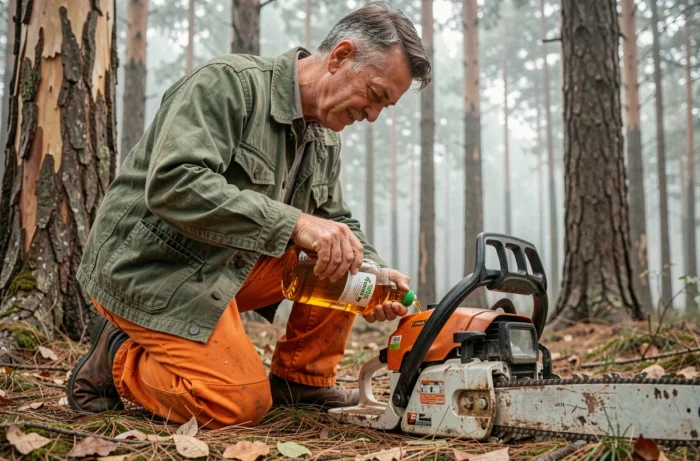
When a chainsaw operates, it releases up to half a liter of lubricant per hour directly into the environment. This chain oil, often mineral-based, ends up in the soil and waterways with no possibility of recovery. Comparing eco-friendly alternatives to chain oil for chainsaws requires measuring three parameters: biodegradability, lubrication performance (stickiness, temperature resistance), and usage cost per liter.
Vegetable oil, frying oil, certified organic oil: comparison of properties
The available alternatives are not equal. Their composition determines both their environmental impact and their behavior on the chain guide.
| Type of lubricant | Base | Biodegradability | Stickiness | Indicative viscosity | Main risk |
|---|---|---|---|---|---|
| Conventional mineral oil | Refined petroleum | Low | High (tackifying additives) | ISO VG 100-150 | Long-term soil contamination |
| Formulated vegetable oil (rapeseed) | Rapeseed or other oilseeds | Fast (OECD tests 301B) | High | ISO VG 100-220 | Resinification if stored for long periods |
| Filtered recycled frying oil | Sunflower, peanut, etc. | Good | Low to medium | Variable, often too fluid | Accelerated wear, frequent cleaning of the guide |
| Certified organic forest oil | Vegetable esters | Fast (OECD tests 201, 202, 203) | High | ISO VG 220 | Higher cost per liter |
This table highlights a clear gap between recycled frying oil and formulated vegetable oil. The former, often mentioned in forums as an economical solution, lacks stickiness. The oil projected by the chain at high speed does not adhere to the metal if it is too fluid. Result: the tank needs to be refilled more often, and wear on the guide increases.
To explore alternatives to chainsaw chain oil with detailed selection criteria, ISO VG viscosity remains the primary indicator to check before any purchase.

OECD certified biodegradability: what the tests really measure
The label “biodegradable” on a chain oil can does not mean much without reference to a specific protocol. Manufacturers of formulated vegetable oils for chainsaws rely on OECD tests 301B for rapid biodegradability. This protocol measures the degradation of the product by microorganisms in an aqueous environment over a defined period.
Certified organic oils go further. They also pass OECD tests 201 (algae), 202 (daphnia), and 203 (fish) to assess their aquatic toxicity. A conventional mineral oil does not meet any of these criteria.
In contrast, recycled frying oil, even if filtered, has not undergone any certification of this type. Its biodegradability is assumed to be good due to its food origin, but its behavior in forest soil after high-speed projection remains undocumented by standardized tests.
The Austrian case: a reference ban
Austria prohibits the use of mineral oil for lubricating chainsaws in forestry work. This regulation, in place for several years, aims to protect soils and groundwater in wooded areas. France does not have an equivalent restriction to date, but this Austrian precedent is guiding the practices of European forestry professionals towards certified vegetable oils.
Recycled frying oil on chainsaws: measurable technical limits
The use of filtered frying oil as chain lubricant frequently appears in user feedback. The principle works as a temporary solution, but technical constraints accumulate with use.
- The viscosity of frying oil is significantly lower than that of ISO VG 100 chain oil, which requires refilling the oil tank when half full of gasoline to avoid running dry
- The lack of tackifying additives reduces adherence on the chain: the lubricant is ejected faster, which decreases protection against friction between links and guide
- The guide needs to be cleaned more frequently, as cooking residues clog the grooves and the lubrication hole
- Sharpening may last less long according to several users, probably due to insufficient lubrication that increases the heating of the teeth
For occasional use (emergency in the forest, small domestic tasks), frying oil remains a backup option. For regular or professional use, the risks of premature wear of the guide and chain outweigh the savings made on the lubricant.
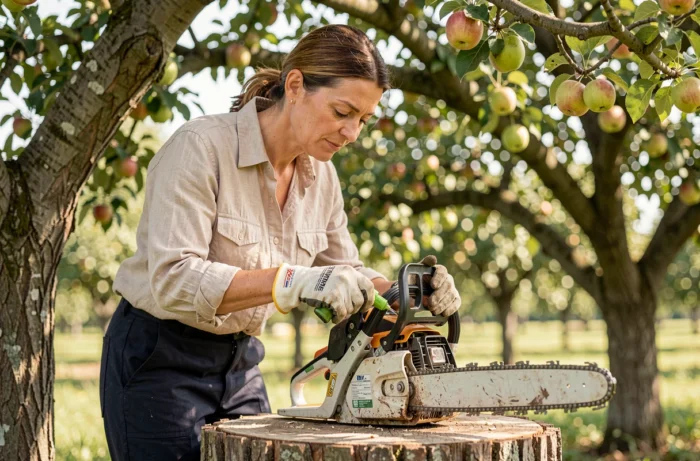
Formulated rapeseed vegetable oil: the best compromise between performance and ecology
Chain oils based on rapeseed formulated for forestry use represent the most advanced category among eco-friendly alternatives. They combine a stickiness comparable to mineral oils and documented rapid biodegradability.
Their main weakness concerns storage. Vegetable esters tend to resinify when left for long periods in a tank or opened can. This phenomenon produces a sticky deposit that can clog the chainsaw’s lubrication circuit.
Storage precautions to avoid resinification
- Empty the oil tank if the chainsaw is not used for several weeks
- Store the opened can away from light and heat, in a ventilated area
- Clean the lubrication circuit at the end of the season with a passage of fresh oil before storage
The cost per liter of these formulated vegetable oils exceeds that of standard mineral oil. Conversely, the reduction of impact on forest soils and compliance with the regulatory requirements emerging in Europe compensates for this gap for professionals.
The choice between mineral oil and eco-friendly alternative boils down to a simple fact: all chain oil ends up in the environment. No system recovers it. Certified biodegradable vegetable oils according to OECD protocols are the only option that combines technical performance and measurable reduction of soil contamination.