
Every year, thousands of high school students fill their sketch margins, accumulate notebooks, and wonder if this daily gesture can lead to something more than a hobby. The question deserves to be asked in concrete terms: which post-baccalaureate programs actually welcome these profiles, with what diplomas at stake and what admission criteria?
DN MADE, DNA, private school: comparison of art and design programs after the bac
The landscape of post-baccalaureate artistic studies is structured around a few well-identified programs, but their access conditions, duration, and recognition vary considerably. Before preparing a Parcoursup application or aiming for an entrance exam, a table clarifies the differences.
| Program | Duration | Recognition | Selection |
|---|---|---|---|
| DN MADE (national diploma in crafts and design) | 3 years | National diploma, bachelor’s degree | Academic record + portfolio + motivation letter via Parcoursup |
| DNA (national diploma in art, art option in fine arts school) | 3 years | National diploma, bachelor’s degree | Entrance exam specific to each school |
| Private school (type bachelor illustration, concept art) | 3 to 5 years | Variable: check registration with the RNCP | Application + interview + portfolio, sometimes creative tests |
| BTS graphic design / visual communication | 2 years | State diploma | Application via Parcoursup |
The DN MADE appears to be the most structured path for a drawing profile that wants to keep options open. It leads to direct employment or further studies in DSAA, DNSEP, or a master’s degree. In contrast, the DNA is more suitable for those aiming for a personal artistic practice, with a program that can be extended by two years towards the DNSEP.
When considering to transform their passion for drawing into a study project, the first reflex is to check the recognition of the targeted diploma. For private schools, the discriminating criterion is registration with the RNCP: an RNCP level 6 title corresponds to a bac+3/4 and guarantees administrative recognition of the course.
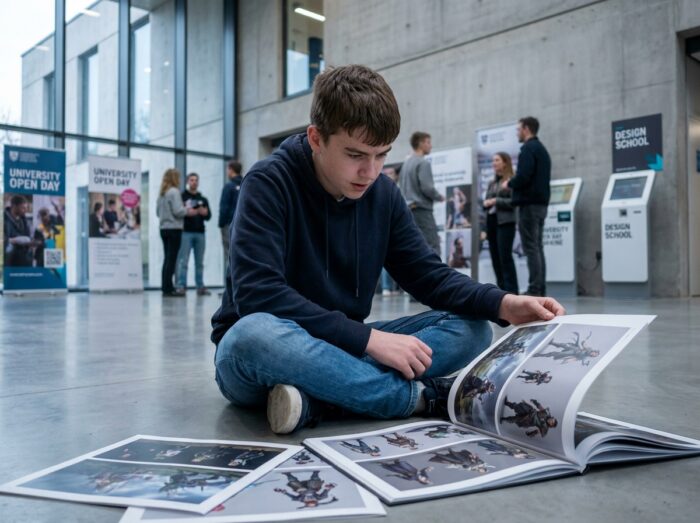
Portfolio and personal project: what really matters in art school selection
High school grades count, but they are just one filter among others. What distinguishes a successful candidate from a rejected one often lies elsewhere.
The portfolio is the centerpiece. It is not just a collection of “nice drawings.” The juries are looking for a process: the ability to experiment with various techniques, coherence of the proposal, and a critical eye on one’s own work. A research notebook showing failed attempts that were then corrected sometimes holds more value than a series of polished renderings.
The personal project, expressed in the motivation letter or during the interview, must answer a simple question: why this specific program and not another? Juries immediately spot generic applications that are copied and pasted from one wish to another.
What the application file must concretely contain
- A selection of personal works showing at least three different techniques (pencil, ink, digital, collage, painting), with a short statement of intent for each piece
- One or two completed projects that tell a story or explore a theme, not just isolated exercises
- Observation sketches (everyday objects, architecture, characters in motion) that prove regular practice of drawing from life
- A short text explaining the candidate’s visual influences and the artistic direction they wish to explore
This requirement for concrete production means that portfolio preparation should start well before the final year. Students who wait until January to gather their drawings often end up with a portfolio that is too thin or too homogeneous.
Real career prospects after a diploma in art and design: beyond graphic designer and illustrator
The common representation of drawing professions often limits itself to two figures: the graphic designer and the illustrator. This view overlooks specializations that actively recruit and where mastery of drawing is a decisive advantage.
Motion design combines animation, typography, and visual storytelling. Communication agencies, production studios, and online content platforms are looking for profiles capable of bringing movement to a graphic identity.
Interaction design (often referred to as UX/UI design) mobilizes drawing skills for rapid prototyping of interfaces. Knowing how to sketch a user journey on paper before moving to software remains an asset that recruiters value.
Concept art, driven by the video game and animation industry, requires a solid foundation in traditional drawing. Schools offering specialized bachelor’s degrees in this field train students to create complete visual universes, from characters to environments.

Transversal skills that drawing develops for these professions
- Composition and management of visual space, applicable in both layout and scenography
- The ability to communicate an idea quickly through sketching, useful in design meetings as well as client presentations
- Sensitivity to colors, contrasts, and visual hierarchy, which applies to all media, from print to digital
- The habit of iteration (drawing, evaluating, correcting), which aligns perfectly with the design work process
Artistic track in high school: plastic arts specialty or STD2A
The choice arises as early as the second year for students who want to prepare a solid application. The plastic arts specialty in the general track offers a significant hourly volume and a theoretical approach that prepares well for the entrance exams of higher art schools.
The technological bac STD2A (sciences and technologies of design and applied arts) adopts a different approach, oriented towards design and crafts. It provides privileged access to the DN MADE without going through a preparatory year.
In contrast, a student in the general track with a plastic arts specialty will often have to create a more extensive portfolio to compensate for the lack of technical training in design. Both paths lead to the same post-bac programs, but through routes with significantly different personal workloads.
The choice between these two paths depends less on drawing talent than on the type of profession targeted. A future object or space designer will benefit from going through the STD2A. A future visual artist or illustrator will find in the general track a broader culture and greater freedom of practice.