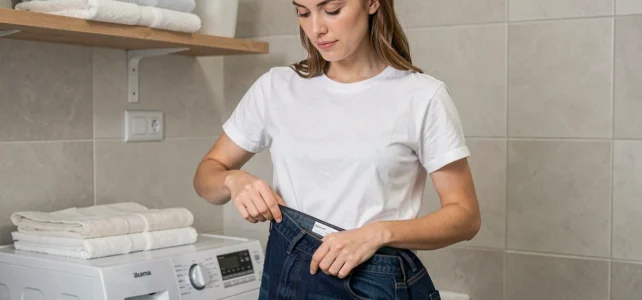
The composition of denim determines everything. A 100% cotton jean and a stretch jean do not react the same way to heat, and applying the wrong method speeds up wear without improving fit. Here, we detail the techniques that actually work to shrink a relaxed jean, taking into account the textile behavior of the fibers.
Dimensional stability of denim: the shrinkage plateau
The majority of shrinkage in a jean occurs during the first two to three wash and dry cycles. Beyond that, the fibers reach a plateau: they hardly move anymore. This phenomenon, confirmed by recent studies on the dimensional stability of fabrics, explains why running high-temperature cycles on a jean that has already been washed several times no longer yields visible results.
We regularly observe jeans returned after five or six intensive washes, with weakened seams and a deformed waistband, but with no size gain. Thermal shrinkage has a physical limit, not an infinite cumulative effect. If the jean has already been worn and washed many times, the textile margin for maneuver is reduced.
Before attempting anything, you need to know how to shrink a relaxed jean based on its washing history and composition, or risk wasting time and damaging the fabric.
Shrinking a 100% cotton jean: heat and cycle control
Pure cotton is the fiber most responsive to thermal shrinkage. The cellulose chains contract under the effect of humid heat, and this contraction can be significant on a raw or lightly washed jean.
Washing at high temperature followed by the dryer
The most reliable method is to wash the jean inside out at a minimum of 60 °C, on a normal cycle. Turning the jean inside out protects the indigo dye, which does not withstand hot friction well. Immediately follow with a tumble dry set to maximum heat.
- Turn the jean inside out before placing it in the machine to preserve the surface color
- Select a cotton program at a minimum of 60 °C, without fabric softener (it lubricates the fibers and cancels the contraction effect)
- Transfer directly to the dryer on high heat, without air drying between the two steps
- Check the fit after a single cycle before starting a second, as two short cycles are better than one extreme cycle
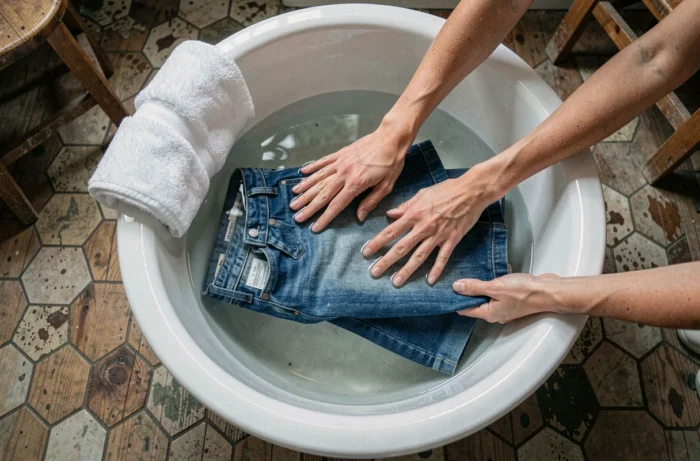
Boiling water bath for more significant shrinkage
When machine washing is not enough, direct soaking in boiling water offers more intense thermal exposure. We recommend immersing the jean in a basin of simmering water for twenty to thirty minutes, keeping it submerged with a utensil.
Boiling water mainly affects the overall length and width of the fabric, not an isolated area. For targeted adjustments (waist, thighs), this method remains approximate. It is better suited for a uniformly relaxed jean.
Stretch jean with elastane: technical limits
A jean containing elastane behaves differently. The elastic fiber loses its recovery capacity over time and washes, but it does not “shrink” in the strict sense: it degrades. Applying high heat to a stretch jean accelerates the breaking of elastane threads without guaranteeing a lasting fit.
Limiting washing to 30 °C and avoiding hot tumble drying remains the recommendation to preserve the longevity of a stretch jean. At high temperatures, elastane ages prematurely: the jean loses its ability to stretch in a controlled manner after each wear.
In practice, a 100% cotton jean can be truly resized through controlled washing. A stretch jean will mainly lose length, not necessarily waist or thigh circumference. The composition listed on the label should guide the choice of method.
Targeted adjustment with steam: waistband and localized areas
Steam allows for localized work that machine washing cannot offer. A steam iron or vertical steamer directed at the waistband, knees, or crotch contracts the fibers in a specific area without wetting the entire jean.
This technique works especially well on cotton. We recommend keeping the iron a few centimeters from the fabric, saturating the area with steam for one to two minutes, and then letting it dry flat. Steam shrinks locally without altering the color or seams.
For the waistband specifically, steaming the inside and then putting on the still-warm jean allows the fabric to reshape around the body. The result generally lasts for one wear, or even two, before the cotton relaxes again.
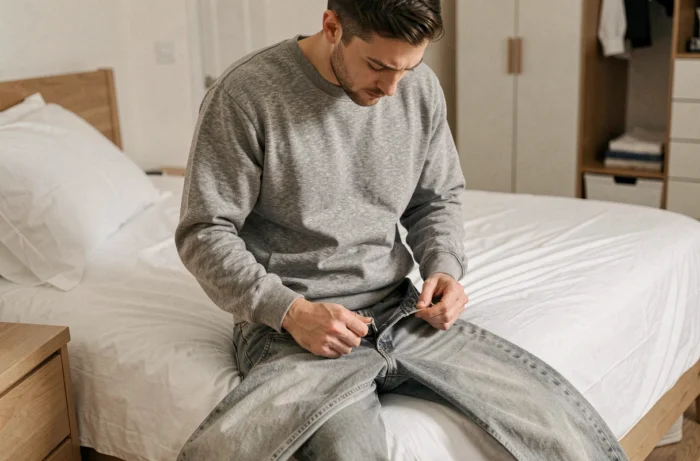
Sewing alteration: the only permanent solution for an oversized jean
When the difference exceeds half a size, no thermal method will fix the problem permanently. Sewing alterations remain the only intervention that truly modifies the structure of the jean. Taking in side seams, adjusting the waistband, or tapering the back provides a stable result over time.
A denim alteration specialist knows how to preserve the original topstitching and seam chain, which maintains the aesthetic of the jean. The cost of altering a waistband or side seams is lower than replacing the jean, especially for a quality piece.
Thermal shrinkage corrects half a size, sewing corrects the rest. Combining an initial controlled wash to slightly tighten the fibers, followed by an alteration to adjust the fit, gives the best result on a jean that has lost its original shape. Before multiplying machine cycles, check the composition, assess the actual size difference, and choose the appropriate method to avoid weakening a fabric that only needed a few stitches.