
When booking at the Théâtre du Palais-Royal, the classic reflex is to take the best available category without looking at the actual layout of the hall. The result: sometimes you end up in the front row with a twisted neck, or on the side with an angle that cuts off a third of the stage.
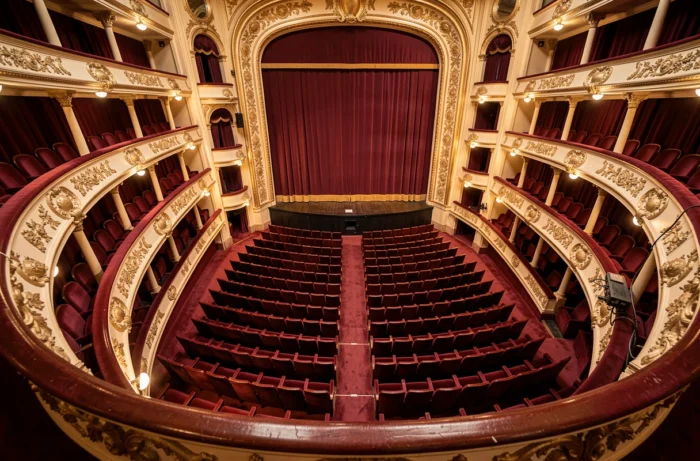
The hall at 38 rue de Montpensier, in Paris, is a compact Italian-style theater. The choice of row and area radically changes the experience from one show to another.
Overhang of the balcony to the orchestra: the trap that the seating plan does not show
On most online seating plans, the last rows of the orchestra appear as clear as the first. In reality, the back rows are located under the overhang of the balcony, which reduces the height of the visible field. In a production with high set elements or video projections, the upper part of the stage frame is lost.
This flaw is rarely mentioned on general ticketing sites. By consulting the seating plan of the Théâtre du Palais-Royal on a specialized site, you can more easily identify the affected areas and avoid paying a high price for truncated visibility.
Feedback varies on this point depending on the shows: for a play performed only at the back of the stage with a low set, the overhang is not much of a hindrance. For a show like Edmond, whose staging exploits verticality, it is a real handicap.
Orchestra of the Théâtre du Palais-Royal: which rows to prioritize
The orchestra remains the most sought-after area, but not all seats offer the same quality. Rows 4 to 8 in the central area provide the best compromise between proximity to the stage and sufficient distance to take in the entire set.
Why to avoid the very front rows
In rows 1 to 3, the view looks down towards the stage. You see the actors very closely, which may seem appealing, but you lose the overall perspective of the staging. In some plays, the upper part of the set completely disappears from view.
The other concrete disadvantage: proximity to the overhead lights. Low side lighting can strain the eyes during a two-hour performance.
Off-center seats in the orchestra
Seats located on the sides of the orchestra offer a diagonal angle to the stage. The further you move away from the central axis, the more you risk losing one side of the stage. These seats are suitable if the price is significantly lower and the show does not rely on a wide use of the stage.
Central balcony, side balcony, and boxes: three different experiences
At the Théâtre du Palais-Royal, the balcony is divided into several areas that have nothing in common in terms of visual comfort.
- Central balcony, rows A to C: complete and unobstructed overhead view. This often provides the best balance between ticket price and visibility quality, especially for spectators who prefer to see the entire stage rather than the expressions of the actors.
- Side balcony: the diagonal angle increases as you move away from the center. A decent view is maintained from the first side seats, but the ends lose part of the stage on the opposite side. Suitable for tighter budgets.
- Side boxes: they bring undeniable historical charm (as it is a listed theater), but visibility remains partial on the opposite edge of the stage. The front boxes, when available, offer a frontal view comparable to that of the central orchestra.

Adapting your seat choice to the scheduled show
A seating plan provides geometry, not artistic context. Two shows performed in the same hall are not experienced the same way depending on the chosen seat.
For an intimate play with two or three actors who stay at the center of the stage, the side seats in the orchestra or balcony work without issue. The action is concentrated in a limited area, and the angle does not obstruct anything.
For a large set show or a musical that uses the full width of the stage, central seats become a priority. You lose too much visual information from an off-center seat when the actors move from one end of the stage to the other.
The case of high-demand shows
For plays like Edmond, which has very favorable reviews from spectators and has been running for several years, the best categories sell out quickly. When only side seats or last rows remain, it is better to choose a central balcony in row A or B rather than an off-center orchestra at the same price. The overall view more than compensates for the distance.
- Check the plan to see if the seat is under the balcony overhang before confirming
- Compare the price between side orchestra and central balcony: the balcony is often cheaper for better visibility
- For spectators under 26, the 10-euro ticket at the box office (Monday to Thursday, one hour before the performance) does not allow for seat selection, but access to the hall is guaranteed within availability limits
The Théâtre du Palais-Royal is a human-sized venue where no seat is truly bad. The difference lies in details: an overhang that cuts off the top of the set, a side angle that masks an exit from the stage. Consulting the plan before purchasing a ticket, cross-referencing the area with the type of show scheduled, remains the most reliable way to avoid disappointment on the night of the performance.