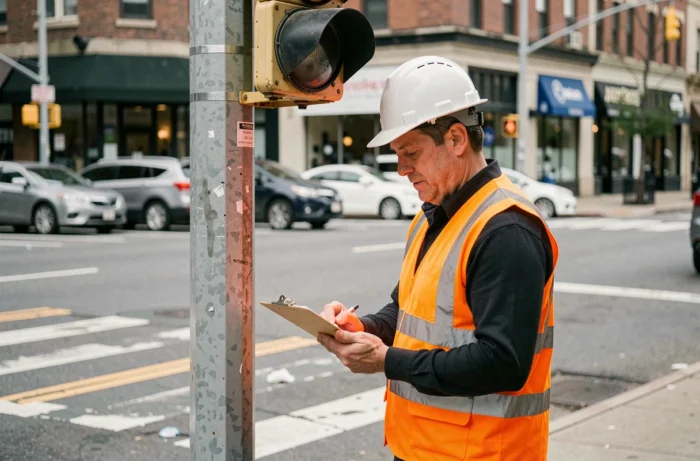
A traffic light stuck on flashing orange, a signal turned off during peak hours, a pedestrian hesitating to cross because the pedestrian light is unresponsive: these situations create confusion and increase the risk of accidents at each affected intersection. Knowing how to spot a malfunctioning traffic light and finding the right contact to report it allows for quick action before a collision occurs.
Traffic light malfunction: distinguishing a real failure from a normal cycle
Before alerting anyone, it is essential to confirm that there is indeed a problem. A traffic light sometimes intentionally switches to a degraded mode, for example at night, to facilitate traffic flow at a little-used intersection. This mode is indicated by a continuously flashing orange.
A real malfunction is recognized differently. Have you noticed a light stuck on a single color for several minutes, all signals off in broad daylight, or a cycle that never seems to give green to one of the lanes? These are reliable signs of a malfunction.
Another less visible case: the pedestrian light remains red permanently despite repeated pressing of the call button. This type of failure often goes unnoticed by drivers, but it directly penalizes pedestrians and people with reduced mobility.
To identify traffic light problems reliably, simply observe the intersection for two or three complete cycles. If no change occurs, or if the behavior of the light does not correspond to a logical pattern, reporting is justified.
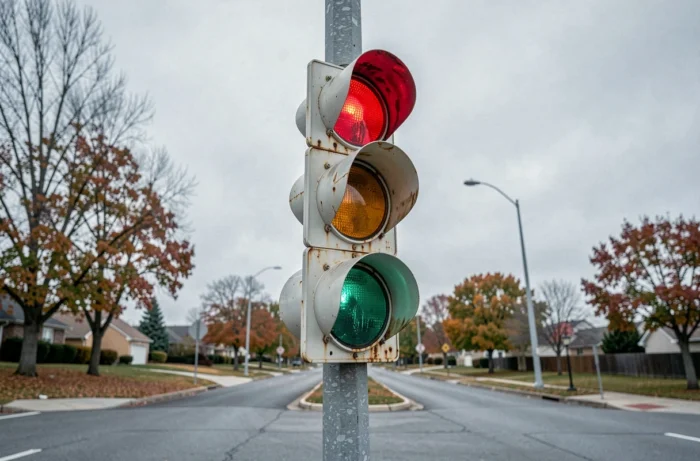
Who manages traffic lights according to the type of road
The answer depends on the road where the light is installed. This distinction is key to reaching the right contact without wasting time.
Municipal and intermunicipal roads
The municipality or intermunicipality is responsible for the majority of traffic lights in the city. The public works department or municipal technical service manages maintenance, cycle programming, and repairs. In urban areas that have transferred this responsibility to an EPCI (public establishment for intermunicipal cooperation), it is the metropolitan area or urban community that takes over.
Some local authorities have also pooled the maintenance of their traffic lights with a departmental energy union. This is the case, for example, in Loudéac, where the Côtes-d’Armor Departmental Energy Union (SDE 22) now carries out this mission on behalf of the municipality.
Departmental and national roads
On a departmental road, the departmental council is responsible. On a national road or an axis managed by the state, the interdepartmental road directorate (DIR) intervenes. In practice, the municipal office number remains the first useful reflex: even if the road is not municipal, the municipal switchboard generally knows how to redirect to the right service.
Reporting a malfunctioning light: concrete channels
You have confirmed the malfunction and identified the likely manager. Now you need to report it effectively. Here are the channels that work, listed in order of speed.
- Phone call to the city hall or municipal police station. This is the most direct channel during the day. The switchboard transfers to the public works department or the traffic command center if it exists.
- Online form or citizen reporting platform. Several metropolitan areas offer a dedicated digital counter with a “traffic lights” category. Montpellier Méditerranée Métropole, for example, has a specific form where you describe the malfunction, locate the intersection, and attach a photo.
- Mobile reporting application. Tools like BetterStreet (used notably in Belgium for municipal roads) or applications specific to certain intermunicipalities allow you to geolocate the problem and track the progress of the request.
In Wallonia, the number 1718 centralizes reports of anomalies on the regional road network, including traffic lights. The WalOnMap application helps determine whether the road is regional or municipal before calling.

Light malfunction at an intersection: immediate safety rules to apply
Reporting takes time. While waiting for repairs, users must adjust their behavior at the affected intersection.
When no additional signage accompanies the light (neither stop nor yield), priority to the right applies automatically. Each vehicle must yield to the one coming from its right, just like at an unregulated intersection.
If a sign is present under the light, it takes over. A stop sign or a “yield” triangle has been installed specifically to cover this malfunction scenario. You must then respect this sign as if there were no light at all.
For pedestrians, the absence of a green pedestrian signal does not eliminate the right to cross. Caution is required: establish eye contact with drivers, cross when the flow is interrupted, and avoid the blind spots of heavy vehicles.
Challenging a ticket received at a malfunctioning light
Receiving a ticket for running a red light when the light was malfunctioning can happen. The defective signaling constitutes a valid reason for contestation.
The process involves a request for exemption addressed to the public prosecutor within 45 days of receiving the notice. Including any supporting evidence strengthens the case: photo of the malfunctioning light, witness statement, confirmation of the report already made to the city hall. A recent report from TF1 reminded that this type of contestation regularly succeeds when the proof of the malfunction is documented.
Keeping a record of your initial report (tracking number on the online platform, confirmation email, time of call) serves both for following up on the repair and as evidence in case of a contested ticket.